Table of Contents
- Why Does This Decision Matter So Much?
- What Are React Native and Flutter?
- How Do They Compare on Performance?
- How Do They Compare on Developer Experience?
- How Do They Compare on Ecosystem and Libraries?
- How Do They Compare on UI and Design?
- How Do They Compare on Hiring and Team Building?
- Which Should You Choose Based on Your Project?
- Frequently Asked Questions
Why Does This Decision Matter So Much?
Choosing the wrong mobile framework does not just waste development time. It creates compounding technical debt that follows your startup for years.
Here is what happens when you choose wrong:
| Consequence | Impact |
|---|---|
| Performance issues on one platform | Frustrated users, negative app store reviews, lower retention |
| Missing native features | Workarounds that break on OS updates |
| Small developer pool | Harder to hire, slower to scale, higher salaries |
| Framework abandoned or deprioritized | Costly migration to a new framework |
| Poor developer experience | Slower iteration speed, more bugs, missed deadlines |
This is not a technology debate. It is a business decision. The framework you choose determines your iteration speed, hiring pool, performance ceiling, and long-term maintenance cost.
Most comparison articles online list feature checkboxes without context. This guide gives you the architectural reasoning behind each trade-off — so you can make a decision based on your specific startup, not someone else’s opinion.
What Are React Native and Flutter?
Before comparing, let’s establish what each framework actually does:
React Native
Built by Meta (Facebook) in 2015. Uses JavaScript and React to build mobile applications that render using native platform components.
How it works: You write JavaScript. React Native translates your UI code into actual native iOS and Android components. The button on screen is a real native button — not a simulation.
Flutter
Built by Google in 2017. Uses Dart language to build mobile applications that render using its own Skia graphics engine.
How it works: You write Dart. Flutter does not use native platform components. Instead, it paints every pixel on screen using its own rendering engine — like a game engine for apps.
| Factor | React Native | Flutter |
|---|---|---|
| Creator | Meta (Facebook) | |
| Language | JavaScript / TypeScript | Dart |
| Release | 2015 | 2017 |
| Rendering | Native platform components | Custom rendering engine (Skia/Impeller) |
| Philosophy | ”Learn once, write anywhere" | "Write once, run anywhere” |
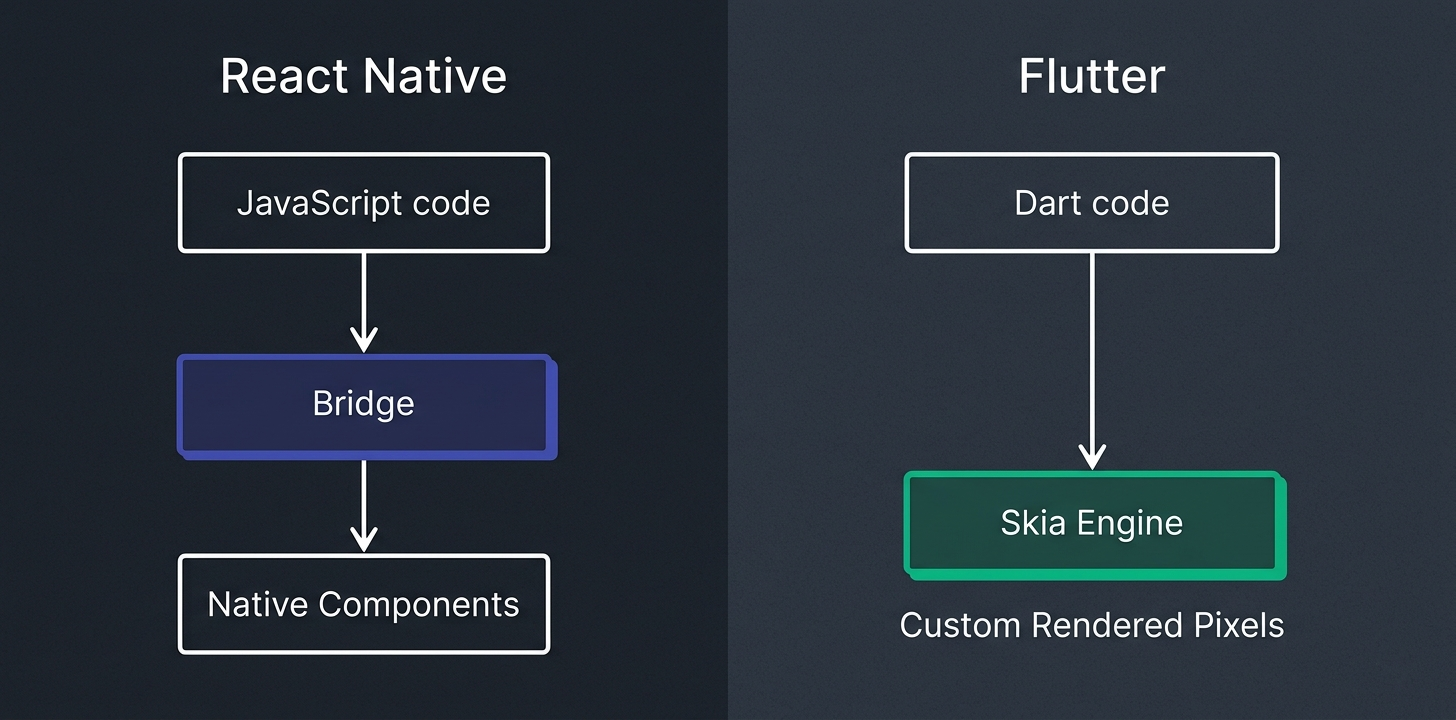
This architectural difference drives every other comparison point below.
How Do They Compare on Performance?
This is the most debated topic — and the most misunderstood.
The Truth About Performance
For 95% of mobile applications, both frameworks deliver performance that users cannot distinguish from fully native apps. The performance debate only matters for:
- Applications with complex animations running at 60fps
- Real-time data visualization with hundreds of elements updating simultaneously
- Graphics-intensive applications (games, 3D rendering)
- Applications processing large datasets on-device
If your startup is building a SaaS dashboard, e-commerce app, social platform, or business tool — both frameworks are fast enough.
Where Performance Actually Differs
| Scenario | React Native | Flutter | Winner |
|---|---|---|---|
| App startup time (cold launch) | 1.5–3 seconds | 1–2 seconds | Flutter |
| Simple UI scrolling (lists, cards) | 60fps native | 60fps rendered | Tie |
| Complex animations (parallax, physics) | Can drop frames on older devices | Consistently smooth | Flutter |
| Heavy computation (data processing) | JavaScript thread can block UI | Dart isolates keep UI smooth | Flutter |
| Memory usage | Lower — uses native components | Higher — renders everything custom | React Native |
| App size (base) | ~7MB | ~12MB | React Native |
The Real-World Impact
| App Type | Performance Difference Users Notice? |
|---|---|
| Business/productivity app | ❌ No — both are fast enough |
| E-commerce app | ❌ No — both handle product grids and checkout flows smoothly |
| Social media app | ⚠️ Minimal — Flutter slightly smoother on complex feeds |
| Real-time dashboard | ⚠️ Minimal — Flutter handles rapid updates slightly better |
| Animation-heavy app | ✅ Yes — Flutter noticeably smoother |
| Game or 3D app | ✅ Yes — neither framework is ideal, go fully native |
Bottom line: Choose Flutter if animations and visual polish are critical to your product. Choose React Native if app size and memory efficiency matter more. For everything else, performance is not the deciding factor.
How Do They Compare on Developer Experience?
This is where the day-to-day reality of building your app lives.
Language: JavaScript vs Dart
| Factor | JavaScript (React Native) | Dart (Flutter) |
|---|---|---|
| Learning curve for web developers | 🟢 None — same language | 🟡 New language to learn |
| Type safety | Optional (TypeScript) | Built-in |
| Async programming | Promises, async/await | Futures, async/await (similar) |
| Community resources | Massive — decades of JS content | Growing — smaller but dedicated |
| Code sharing with web app | ✅ Share business logic with React web | ❌ Dart only runs in Flutter |
If your team already knows JavaScript, React Native has zero language learning curve. This saves 2–4 weeks of ramp-up time.
If you are hiring fresh or building from scratch, Dart is a cleaner, more consistent language with fewer historical quirks than JavaScript.
Hot Reload
Both frameworks support hot reload — you change code and see the result instantly without restarting the app. Flutter’s hot reload is slightly faster and more reliable, but both are excellent.
Debugging
| Factor | React Native | Flutter |
|---|---|---|
| Chrome DevTools support | ✅ Full | ❌ No — uses Dart DevTools |
| Error messages | 🟡 Sometimes cryptic (bridge errors) | 🟢 Clear and specific |
| Platform-specific debugging | Requires Xcode/Android Studio knowledge | Requires Xcode/Android Studio knowledge |
| Third-party debugging tools | Flipper, Reactotron | Flutter Inspector |
Developer Satisfaction
Stack Overflow’s 2025 Developer Survey shows Flutter consistently ranking higher in developer satisfaction than React Native. Developers cite:
- More consistent behavior across platforms
- Better documentation
- Fewer platform-specific workarounds needed
- More predictable build process
How Do They Compare on Ecosystem and Libraries?
Your framework is only as strong as the packages available to build with.
Package Ecosystem Size
| Metric | React Native | Flutter |
|---|---|---|
| Total packages available | ~25,000+ on npm | ~40,000+ on pub.dev |
| Mature, production-ready packages | 🟢 Large selection | 🟡 Growing but younger |
| Native module support | 🟢 Strong — large community maintaining bridges | 🟡 Good — improving with FFI |
| Enterprise packages (auth, payments, analytics) | 🟢 Mature (Stripe, Auth0, Firebase) | 🟢 Mature (Stripe, Firebase, Supabase) |
The Real Difference
React Native has been around since 2015. Its ecosystem has had 11 years to mature. When you need a specific integration — say, a barcode scanner for a logistics app or a Bluetooth library for an IoT device — React Native almost certainly has a battle-tested package.
Flutter’s ecosystem is younger but growing faster. For common integrations (Firebase, Stripe, camera, maps, local storage), Flutter’s packages are equally mature. The gap only shows for niche, platform-specific integrations.
| Integration | React Native | Flutter |
|---|---|---|
| Firebase | ✅ Mature | ✅ Mature |
| Stripe payments | ✅ Mature | ✅ Mature |
| Google Maps | ✅ Mature | ✅ Mature |
| Push notifications | ✅ Mature | ✅ Mature |
| Bluetooth / IoT | ✅ Battle-tested | 🟡 Works but fewer options |
| AR / Camera advanced | ✅ More options | 🟡 Catching up |
| In-app purchases | ✅ Mature | ✅ Mature |
| Deep linking | ✅ Mature | ✅ Mature |
Bottom line: If your app needs common integrations, both ecosystems are equally capable. If your app needs niche hardware or platform-specific features, React Native currently has a wider selection.
How Do They Compare on UI and Design?
This is where the architectural difference creates the biggest visible impact.
React Native’s Approach: Native Components
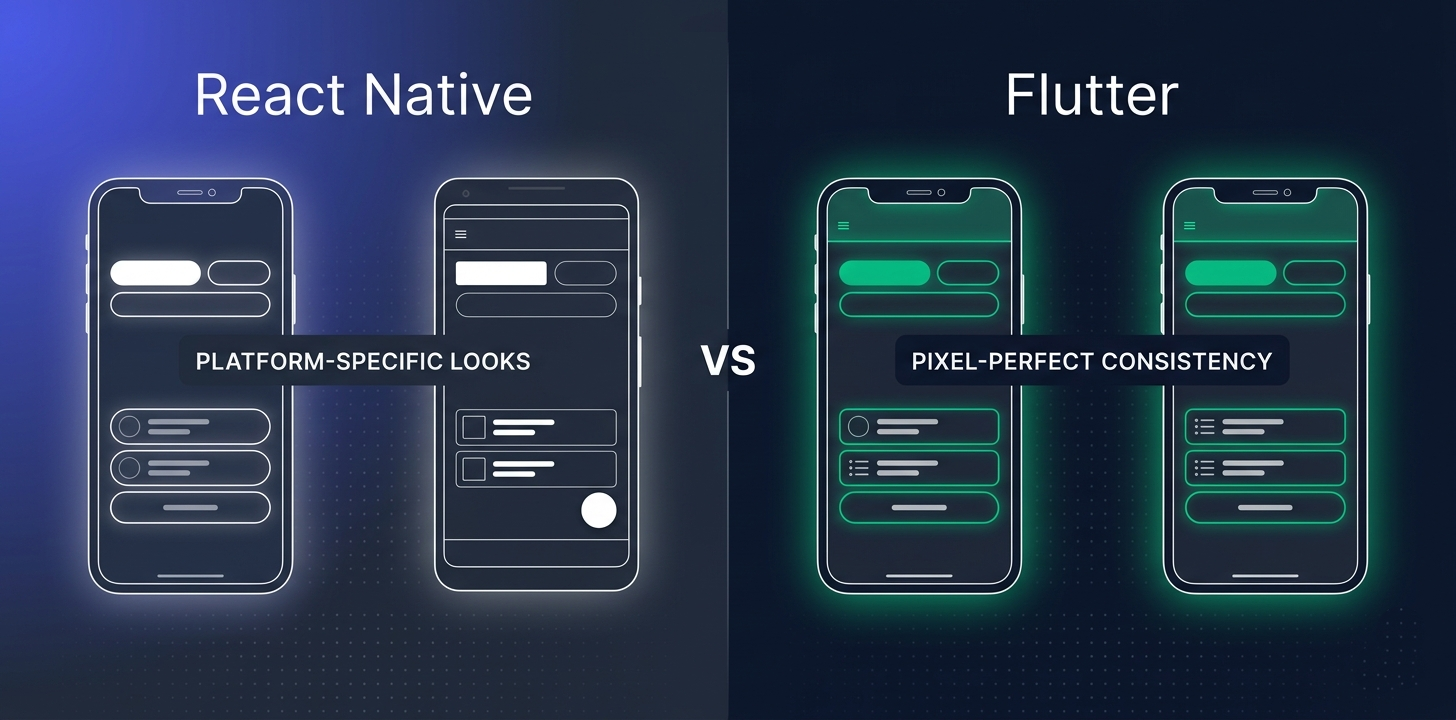
React Native renders actual platform components. A button on iOS looks like an iOS button. A switch on Android looks like an Android switch. Your app automatically follows each platform’s design language.
Advantage: Users feel at home — the app behaves exactly like other native apps on their device.
Disadvantage: Making both platforms look identical requires extra work. If your brand demands pixel-perfect consistency across iOS and Android, you fight against the framework.
Flutter’s Approach: Custom Rendering
Flutter draws every pixel itself. A button looks exactly the same on iOS and Android because Flutter is not using native components — it is painting the button from scratch.
Advantage: Pixel-perfect brand consistency across platforms. Your app looks identical everywhere.
Disadvantage: The app may not feel “native” to platform purists. iOS users expect certain interaction patterns that Flutter must manually implement.
| Factor | React Native | Flutter |
|---|---|---|
| Platform-native look | ✅ Automatic | ❌ Requires manual implementation |
| Brand consistency across platforms | 🟡 Requires extra work | ✅ Automatic |
| Custom UI design freedom | 🟡 Limited by native component constraints | ✅ Total freedom — paint anything |
| Material Design support | ✅ Via libraries | ✅ Built-in |
| Cupertino (iOS) design | ✅ Native by default | 🟡 Available but requires effort |
| Complex custom animations | 🟡 Possible but harder | ✅ Built-in animation framework |
Bottom line: Choose React Native if you want your app to feel native on each platform. Choose Flutter if you want your app to look identical everywhere with maximum design freedom.
How Do They Compare on Hiring and Team Building?
This is the factor most technical articles ignore — and it is often the one that matters most for startups.
Developer Availability
| Metric | React Native | Flutter |
|---|---|---|
| Global developer pool | 🟢 Very large — any React/JS developer can learn quickly | 🟡 Large and growing fast |
| Average salary range | $60K–$120K | $65K–$130K |
| Time to hire | 🟢 Faster — larger candidate pool | 🟡 Slightly longer |
| Junior developer availability | 🟢 Abundant | 🟡 Growing |
| Senior developer availability | 🟡 Competitive market | 🟡 Competitive market |
The JavaScript Advantage
React Native’s biggest hiring advantage is JavaScript. Your React Native developer can also:
- Build your web dashboard using React
- Write backend APIs in Node.js
- Maintain your marketing website
- Debug cross-platform issues using familiar tools
One JavaScript developer covers your entire stack. A Flutter developer writes Dart — which is only useful inside Flutter. If you need a web dashboard, you need a separate web developer.
The Flutter Counter-Argument
Flutter now supports web, desktop (Windows, macOS, Linux), and embedded platforms — all from a single Dart codebase. A Flutter developer can theoretically build your mobile app, web app, and desktop app using one framework.
In practice, Flutter web is still maturing. It works well for app-like web experiences but is not ideal for content-heavy or SEO-dependent websites. For most startups, a separate web solution is still necessary.
| Scenario | Better Choice |
|---|---|
| Your team already knows JavaScript | React Native |
| You need web + mobile code sharing | React Native (JS everywhere) |
| You are building a brand-new team | Flutter (cleaner language, better docs) |
| You want one codebase for mobile + desktop | Flutter |
| You need to hire fast in a tight market | React Native (larger pool) |
Which Should You Choose Based on Your Project?
Stop asking “which is better” and start asking “which fits my situation.”
Choose React Native If:
- Your team already knows JavaScript or React
- You need to share code between your web app and mobile app
- You want your app to feel native on each platform
- You need access to niche native packages (Bluetooth, AR, IoT)
- Hiring speed matters — you need developers fast
- You are building a custom web application alongside the mobile app
Choose Flutter If:
- You are starting fresh with no existing codebase
- Brand consistency across platforms is critical
- Your app is animation-heavy or has complex custom UI
- You want to target mobile, web, and desktop from one codebase
- Your team is willing to learn Dart
- You prioritize developer experience and code quality
The Decision Matrix
| Factor | Weight for Most Startups | React Native | Flutter |
|---|---|---|---|
| Time to market | 🔴 Critical | ✅ Faster if team knows JS | ✅ Faster if starting fresh |
| Performance | 🟡 Important | ✅ Good enough | ✅ Slightly better |
| Design flexibility | 🟡 Important | 🟡 Platform-native | ✅ Total freedom |
| Ecosystem maturity | 🟡 Important | ✅ More mature | ✅ Catching up fast |
| Hiring | 🔴 Critical | ✅ Larger pool | 🟡 Growing pool |
| Code sharing with web | 🟡 Important | ✅ JavaScript everywhere | 🟡 Flutter web is maturing |
| Long-term maintenance | 🔴 Critical | ✅ Backed by Meta | ✅ Backed by Google |
| Community support | 🟡 Important | ✅ Massive | ✅ Large and passionate |
FoudaTech’s Recommendation
At FoudaTech, I build production mobile applications with both frameworks. My recommendation for most startups in 2026:
Start with Flutter if you are building a new product from scratch. The developer experience is superior, the UI consistency is effortless, and the performance ceiling is higher. Google’s investment in Flutter continues to accelerate.
Start with React Native if you already have a JavaScript team or a React web application. The code sharing advantage and hiring pool make it the pragmatic choice when you are not starting from zero.
Either way, the framework matters less than the architect. A senior engineer shipping clean, well-tested code on React Native will outperform a junior team struggling with Flutter — and vice versa. The human building your app matters more than the tool they use.
Discuss your mobile app project →
Frequently Asked Questions
Is Flutter replacing React Native?
No. Both frameworks are growing simultaneously. Flutter is growing faster in adoption, but React Native maintains a larger installed base. Meta continues investing heavily in React Native — the new architecture (Fabric and TurboModules) shipped significant performance improvements. Neither framework is dying.
Can I switch from React Native to Flutter later?
Yes, but it is essentially a full rewrite. The languages are different (JavaScript vs Dart), the UI paradigms are different (native components vs custom rendering), and the project structure is different. Budget for the same timeline as your original build. This is why choosing correctly from the start matters.
Which has better app store approval rates?
Both have identical approval rates. Apple and Google review the user experience, not the framework. A well-built Flutter app and a well-built React Native app both pass review without issues. Problems arise from poor implementation, not framework choice.
Can I build for web and mobile with one codebase?
React Native: You can share business logic (API calls, data processing, state management) between React Native mobile and React web — but the UI layer requires separate code for each platform.
Flutter: You can share the entire codebase including UI across mobile, web, and desktop. However, Flutter web performance and SEO capabilities are still maturing. For content-heavy or SEO-critical websites, a separate web solution is recommended.
Which should I choose for an MVP?
For a pure MVP where speed matters most — choose whichever framework your developer knows best. A React Native MVP built by an experienced React Native developer will ship faster and better than a Flutter MVP built by someone learning Flutter. Match the framework to the engineer, not the other way around.
How much does it cost to build a mobile app with either framework?
Cost is driven by complexity, not framework choice. Both frameworks require similar engineering effort for equivalent features. The cost difference comes from your team structure — a solo full-stack architect delivers the same quality at 30–50% below agency pricing regardless of which framework is used. Get a project estimate →
Does FoudaTech prefer one framework over the other?
I ship production apps with both. My recommendation depends entirely on your specific situation — existing team skills, product requirements, and long-term technical strategy. There is no universally correct answer. Let’s discuss your project →