Table of Contents
- Why Is Custom Web App Pricing So Confusing?
- What Are the Core Factors That Drive Development Cost?
- What Are the Three Tiers of Web Application Complexity?
- Where Do Founders Waste the Most Money?
- How Does a Solo Architect Compare to an Agency?
- How Should You Budget for a Custom Web Application?
- Frequently Asked Questions
Why Is Custom Web App Pricing So Confusing?
Ask five developers how much a custom web application costs and you will get five completely different answers. This is not because developers are dishonest — it is because they are not building the same thing.
A landing page is not a SaaS platform. A brochure site is not a real-time analytics dashboard. A contact form is not a multi-tenant enterprise system with role-based access control.
The price depends entirely on three variables:
- What you are building (features, complexity, scale)
- How it needs to perform (speed, security, compliance)
- Who is building it (solo architect, small team, agency)
Most pricing guides online throw out dollar ranges without explaining the engineering decisions behind them. This guide is different. You will understand exactly what drives cost — so when you receive a quote, you know whether it is fair.
What Are the Core Factors That Drive Development Cost?
Every custom web application is priced based on these six factors. Understanding them gives you negotiating power:
| Factor | Low Complexity | High Complexity |
|---|---|---|
| Number of screens | 3–5 core screens | 15–30+ screens with sub-views |
| Authentication | Basic email/password login | Multi-role access, SSO, 2FA |
| Data model | Simple CRUD operations | Relational models with complex queries |
| Integrations | None or 1 API | Payment, CRM, email, analytics, webhooks |
| Real-time features | None | Live chat, collaborative editing, dashboards |
| Compliance | None | HIPAA, PCI-DSS, GDPR audit trails |
Each jump from low to high complexity on any single factor can increase total cost by 20–40%. When multiple factors are high complexity simultaneously, costs compound.
Why Do Real-Time Features Cost Significantly More?
If your application needs live updates — chat systems, collaborative editing, real-time dashboards — expect a meaningful cost increase. Real-time architecture requires:
- WebSocket infrastructure instead of simple request-response patterns
- State synchronization across multiple connected clients
- Conflict resolution logic when two users edit the same data
- Persistent connection management that scales with concurrent users
A standard dashboard that refreshes when you reload the page costs far less than one that updates every second without any user action.
Why Do Third-Party Integrations Add Up Fast?
Every external API integration adds layers of complexity that are invisible to non-engineers:
- Authentication flows — OAuth, API keys, token refresh cycles
- Error recovery — what happens when the third-party API goes down at 2am
- Webhook processing — receiving and validating real-time events from external systems
- Version management — external APIs change their contracts without warning
A single payment processor integration (Stripe, PayPal) can take a week of engineering time. Add a CRM, email service, analytics platform, and shipping API — each one adds that same layer of work.
What Are the Three Tiers of Web Application Complexity?
Rather than giving you arbitrary dollar ranges, here is what each tier actually includes from an engineering perspective:
Tier 1: Validation Build (MVP)
Purpose: Test a concept with real users before committing significant capital.
What you get:
- 3 to 5 core screens (authentication, dashboard, one primary workflow)
- Responsive frontend built with modern JavaScript and Tailwind CSS
- Basic API backend with database
- Deployment to production environment
- Typical timeline: 2 to 4 weeks
What you do not get:
- Complex integrations
- Admin dashboards
- Mobile applications
- Advanced analytics
Who this is for: Pre-seed founders who need to prove product-market fit before raising capital. If you are not sure whether users want your product, this is where you start.
Tier 2: Production Application
Purpose: A robust system that handles real traffic, real transactions, and real business operations.
What you get:
- Full feature set (10 to 20 screens)
- Authentication with role-based access control
- Payment integration
- Admin dashboard for content and user management
- API integrations with third-party services
- Performance optimization for Core Web Vitals
- Typical timeline: 4 to 10 weeks
Who this is for: Funded startups, growing businesses, and companies replacing spreadsheets or manual processes with custom software.
Tier 3: Enterprise Platform
Purpose: Mission-critical system with high concurrency, complex business logic, and strict security requirements.
What you get:
- Multi-tenant architecture
- Real-time data processing and synchronization
- Advanced security (encryption at rest, audit logging, compliance)
- Microservices or modular monolith architecture
- CI/CD pipelines and automated testing
- Typical timeline: 3 to 6 months
Who this is for: Series A+ startups, mid-market companies, and enterprises replacing legacy systems.
| Tier | Screens | Timeline | Integrations | Best For |
|---|---|---|---|---|
| MVP | 3–5 | 2–4 weeks | 0–1 | Validating product-market fit |
| Production | 10–20 | 4–10 weeks | 3–5 | Funded startups scaling operations |
| Enterprise | 20–30+ | 3–6 months | 5–10+ | Mission-critical business systems |
Where Do Founders Waste the Most Money?
After engineering applications for startups and mid-market companies, I have identified four patterns that consistently burn capital without producing results.
1. Building Everything Before Launching Anything
The most expensive mistake in software development is building features nobody uses. Half of the features in most product roadmaps never get meaningful adoption — but they all cost engineering time.
The fix: Launch with core functionality. Get real user feedback. Then invest in the features users actually request. A $15,000 MVP that validates your concept saves you from a $80,000 full build that nobody wants.
2. Choosing the Wrong Architecture Early
A monolithic application built on WordPress might work for your first 100 users. It will collapse at 10,000. Rebuilding a slow, poorly architected application from scratch costs more than building it correctly the first time.
| Architecture Decision | Short-Term Savings | Long-Term Cost |
|---|---|---|
| Cheap shared hosting | Save initially | Downtime during traffic spikes, lost revenue |
| No caching strategy | Faster initial build | Database overload, slow page loads, poor SEO |
| Monolithic frontend | Simpler to start | Full rebuild needed when scaling |
| No automated testing | Ship faster initially | Bugs in production, emergency fixes, lost users |
| Skip security hardening | Save a few days | Data breach costs, legal liability, destroyed trust |
The fix: Invest in proper architecture from day one. Sub-second load times, horizontal scaling capability, and security hardening should be baseline requirements — not upgrades you add later when things break.
3. Paying for Organizational Overhead
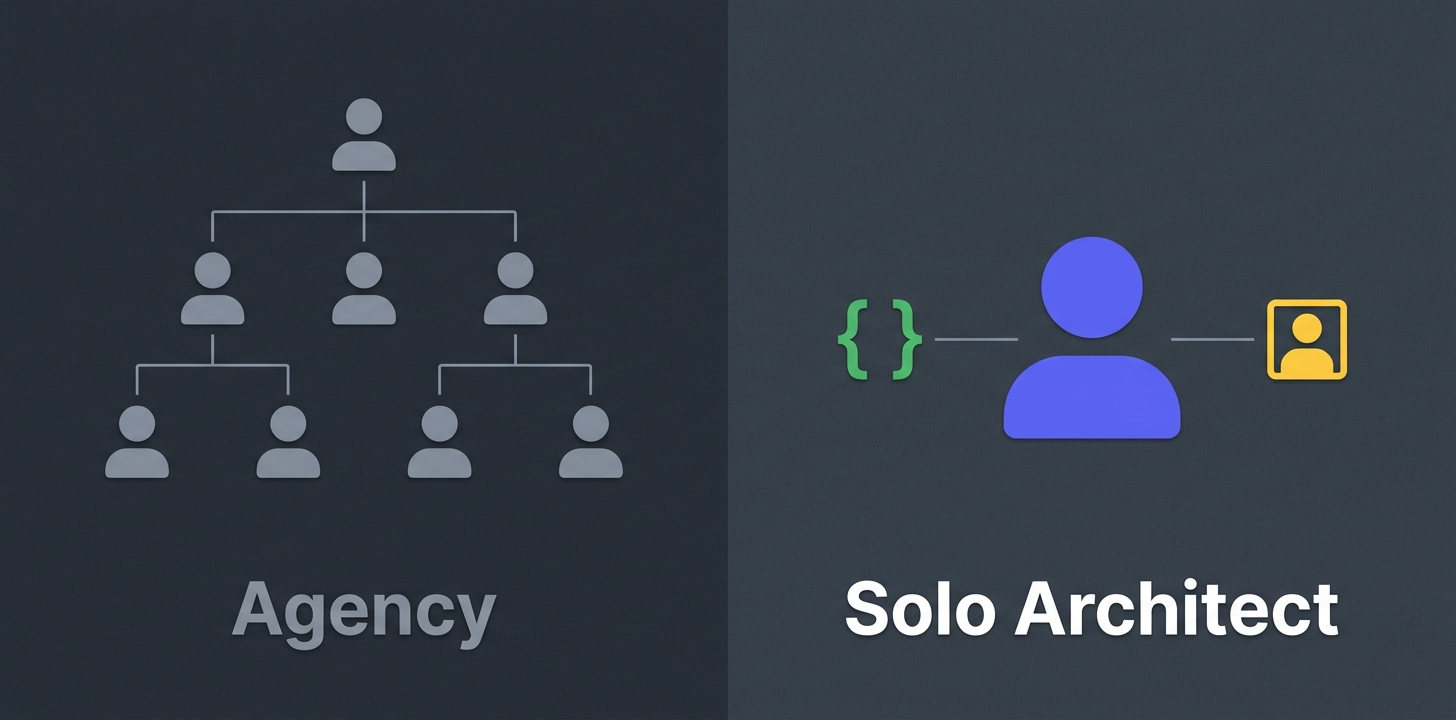
This is the silent budget killer. When you hire a development agency, your budget is split between people who write code and people who manage people who write code.
A typical agency project team looks like this:
- Project manager (does not write code)
- Account manager (does not write code)
- UX designer
- Frontend developer
- Backend developer
- QA tester
- DevOps engineer
That is seven people on your project. Three of them never touch your codebase. Your requirements pass through multiple layers of communication before reaching the person actually building your application.
Every layer adds:
- Communication delay — your feedback takes 24–48 hours to reach the developer
- Context loss — your intent gets diluted through interpretation layers
- Billing hours — you pay for every meeting, every status update, every internal sync
The fix: Work with fewer, more senior engineers who own the entire stack. More on this below.
4. Ignoring Performance Until Launch Day
Google penalizes slow websites. Users abandon pages that take more than 3 seconds to load. Yet many development teams treat performance as an afterthought — something to “optimize later.”
Later never comes. Or when it does, it requires refactoring half the codebase.
The fix: Demand Core Web Vitals benchmarks as part of every project milestone. Performance should be measured continuously, not audited once at the end.
How Does a Solo Architect Compare to an Agency?
This is not about solo developers being universally better than agencies. It is about understanding the cost structure so you can make an informed decision.
The Agency Cost Structure
| Cost Component | What You Pay For |
|---|---|
| Engineering time | The actual code being written |
| Project management | Internal coordination you could handle yourself |
| Account management | Relationship management and upselling |
| QA overhead | Testing that senior engineers do during development |
| Office and infrastructure | Their rent, tools, and operational costs |
| Profit margin | Typically 30–50% markup on engineering cost |
When an agency quotes a project, you are paying for their entire organizational structure — not just the engineering output.
The Solo Architect Cost Structure
| Cost Component | What You Pay For |
|---|---|
| Engineering time | Architecture, frontend, backend, deployment — all one person |
| Direct communication | You talk to the person writing your code |
| That is it | No markup on coordination, no management layer |
The Real-World Difference
| Factor | Agency (6–8 person team) | Solo Architect |
|---|---|---|
| Communication speed | 24–48 hours through PM | Same-day direct response |
| Decision-making | Committee-driven | Architect decides, executes |
| Context retention | Fragmented across team | 100% retained by one person |
| Code consistency | Multiple coding styles | Single consistent architecture |
| Accountability | Diffused across team | One person, full ownership |
| Overhead markup | 30–50% | Zero |
The trade-off is real: A solo architect cannot parallelize work the way a team can. Enterprise platforms with aggressive timelines may need multiple engineers working simultaneously. But for MVP through production-scale applications, one senior architect often delivers faster than a team of six — because there is zero coordination overhead.
The best code is written by small teams with complete context. The worst code is written by large teams with fragmented ownership.
How Should You Budget for a Custom Web Application?
Start with the Problem, Not the Feature List
Before asking “how much does it cost to build X,” ask “what business problem am I solving and what is that solution worth to my company?”
If a custom application saves your operations team 20 hours per week, that is over $50,000 annually in labor costs. Suddenly a $40,000 build pays for itself in under a year.
Budget in Phases, Not Lump Sums
| Phase | Purpose | When to Invest |
|---|---|---|
| Phase 1: MVP | Validate the concept with real users | Before raising capital |
| Phase 2: Production | Scale features based on real feedback | After product-market fit |
| Phase 3: Optimization | Performance, security, integrations | After consistent revenue |
| Phase 4: Expansion | Mobile apps, new markets, advanced features | After operational stability |
Each phase should be a separate engagement with clear deliverables. Do not sign a single contract for all four phases — you need the flexibility to pivot based on what you learn.
Own Your Code from Day One
Ensure your contract includes:
- Full source code ownership — the code is yours, not licensed
- Deployment documentation — how to deploy without the original developer
- No vendor lock-in — your application runs on standard infrastructure, not proprietary platforms
- Handoff capability — any competent engineer should be productive in your codebase within a week
This is non-negotiable. If your developer disappears, you should not lose your entire technology investment.
Allocate Maintenance Budget
Every application needs ongoing maintenance — security patches, dependency upgrades, bug fixes, and feature iterations. Budget 15–20% of your initial build cost annually for maintenance. This is not optional. Unmaintained software becomes a security liability within 12 months.
Get a custom project estimate →
Frequently Asked Questions
Why do different developers quote wildly different prices for the same project?
Because they are not building the same thing. One developer might quote for a basic frontend with a template backend. Another quotes for a fully custom architecture with automated testing, CI/CD pipelines, and performance optimization. Always compare quotes based on deliverables and architecture — not just the final number.
Should I start with a no-code tool and migrate later?
For validation, no-code tools can work. But migration costs are real — rebuilding from no-code to custom code is often more expensive than building custom from the start, because no-code architectures do not translate cleanly to production codebases. If you are confident in your concept, skip no-code and invest in a proper MVP.
How do I know if a developer’s quote is fair?
Ask them to break down the quote by component — authentication, database design, API development, frontend, deployment, testing. If they cannot itemize, they are guessing. A senior engineer should be able to explain exactly where your money goes.
Is it cheaper to hire a full-time developer instead of contracting?
For a single project, contracting is almost always more cost-effective. A full-time senior developer costs $80,000–$150,000+ annually in salary, benefits, and equipment — before they write a single line of your project code. A contracted architect delivers the project and moves on. Hire full-time when you need continuous feature development, not for a defined build.
What happens if I run out of budget mid-project?
This is why phased budgeting matters. If Phase 1 (MVP) is delivered as a standalone product, you have a working application even if you pause development. With a phased contract, you never risk paying for an unfinished, unusable system.
How much should I budget for ongoing maintenance after launch?
Plan for 15–20% of your initial build cost annually. This covers security updates, dependency upgrades, bug fixes, and minor feature additions. Skipping maintenance does not save money — it creates technical debt that costs significantly more to fix later.