
Table of Contents
- Why Do Startups Default to Hiring Agencies?
- What Are the 6 Structural Problems with the Agency Model?
- How Do Communication Layers Kill Startup Speed?
- Why Do Agencies and Startups Have Misaligned Incentives?
- What Does the Data Say About Agency Project Success Rates?
- What Are the Alternatives to Agency Development?
- How Should a Founder Choose Their Development Partner?
- Frequently Asked Questions
Why Do Startups Default to Hiring Agencies?
The logic sounds bulletproof. You need a web application built. You are not a developer. You find an agency with a polished website, a portfolio of logos, and a sales team that promises to “bring your vision to life.”
It feels safe. A company with 30 employees must be more reliable than one person. A team of specialists must produce better results than a generalist. A project manager dedicated to your account must mean your project gets attention.
Every one of these assumptions is wrong — and they cost startups thousands of dollars and months of wasted time before founders realize it.
This is not an opinion piece. These are structural problems with the agency model that consistently produce failed startup projects. Understanding them before you sign a contract can save your company.
What Are the 6 Structural Problems with the Agency Model?
| # | Problem | What Happens | Impact on Your Startup |
|---|---|---|---|
| 1 | Communication layers | Your feedback passes through 2–3 people before reaching the developer | Features get built wrong, iterations take days instead of hours |
| 2 | Misaligned incentives | Agency profits from longer timelines | Projects expand beyond original scope and budget |
| 3 | Fragmented ownership | 4–7 people touch your codebase | Inconsistent architecture, integration bugs, blame shifting |
| 4 | Template-driven development | Agencies reuse frameworks across clients | Your “custom” application is built on the same boilerplate as everyone else |
| 5 | Knowledge loss on rotation | Developers rotate between client projects | New developer spends weeks understanding what the previous one built |
| 6 | Vendor lock-in | Agency uses proprietary tools or hosting | You cannot leave without rebuilding from scratch |
These are not occasional failures. They are built into the agency business model. Let me break down the most destructive ones.
How Do Communication Layers Kill Startup Speed?
In a startup, speed is survival. Every week your product is not in front of users is a week your competitor gets ahead. The agency model structurally slows you down.
Here is how a single piece of feedback travels through an agency:
The Agency Communication Chain
- You send feedback to your account manager
- Account manager interprets your feedback and writes a brief
- Project manager reviews the brief and creates a task
- Developer reads the task and asks clarifying questions
- Project manager relays the question back to the account manager
- Account manager asks you for clarification
- You clarify
- The chain reverses back down to the developer
Total elapsed time for one feedback loop: 2–5 business days.
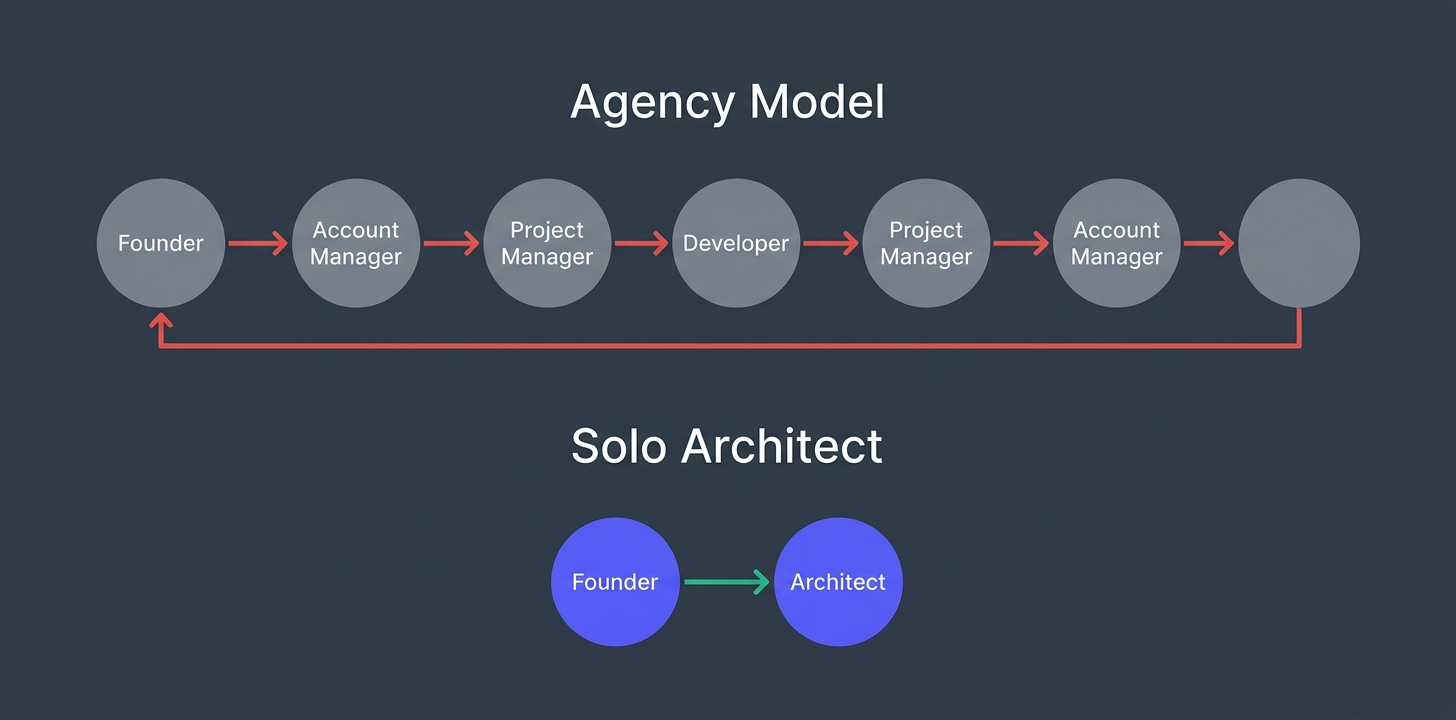
Now compare this to working directly with a solo architect:
- You send feedback directly to the architect
- Architect reads it, asks any clarification in the same conversation
- Architect implements the change
Total elapsed time: same day.
| Metric | Agency Model | Direct Architect |
|---|---|---|
| Feedback loop time | 2–5 business days | Same day |
| Iterations per week | 1–2 | 5–10 |
| Misinterpretation rate | High (multiple translators) | Near zero (single conversation) |
| Context retention | Fragmented across team | 100% retained |
| Decision speed | Committee-driven | Immediate |
Over a 10-week project, an agency delivers roughly 15 feedback iterations. A solo architect delivers 60–80. That is not a marginal difference — it is the difference between shipping a product that matches your vision and shipping whatever the team interpreted your vision to be.
Why Do Agencies and Startups Have Misaligned Incentives?
This is the problem nobody talks about openly. The agency business model creates a structural conflict of interest with startup clients.
How Agencies Make Money
Agencies bill in one of two ways:
Hourly billing: The agency profits when projects take longer. Every “unexpected complexity,” every scope expansion, every additional meeting is additional revenue. There is zero financial incentive to finish your project efficiently.
Fixed-price billing: The agency profits when they deliver the minimum viable interpretation of your requirements using the least engineering effort. Quality suffers because every hour of polish reduces their margin.
Neither model aligns with what you actually want: the best possible product delivered as efficiently as possible.
How This Plays Out in Practice
| Scenario | Agency Incentive | Your Interest |
|---|---|---|
| Feature takes 3 days but could be done in 1 | Bill 3 days (hourly) or cut corners (fixed) | Get it done properly in 1 day |
| Scope needs adjustment mid-project | Change order = new revenue | Pivot quickly without cost penalty |
| Bug found in production | Bill for fix (hourly) or dispute responsibility (fixed) | Bug should not exist — proper testing prevents it |
| Project could launch 2 weeks early | No incentive to accelerate | Launch early = faster revenue |
A solo architect billing project-based has the opposite incentive structure. Finishing faster means moving to the next client. Delivering quality means referrals and reputation. Preventing bugs means not dealing with emergency fixes at midnight.
What Does the Data Say About Agency Project Success Rates?
The numbers are uncomfortable for the agency industry:
| Metric | Industry Average |
|---|---|
| Software projects delivered on time | 29% |
| Software projects delivered on budget | 27% |
| Projects with scope creep | 52% |
| Features never used by end users | 45% |
| Projects considered failed by stakeholders | 19% |
Sources: Standish Group CHAOS Report, PMI Pulse of the Profession
These numbers include enterprise projects with massive budgets and experienced procurement teams. For startups working with agencies for the first time, the failure rate is significantly higher — because startups lack the internal project management expertise to hold agencies accountable.
Why Do These Numbers Exist?
The root causes map directly back to the six structural problems:
| Failure Mode | Root Cause |
|---|---|
| Over budget | Communication layers create misinterpretation → rework → additional billing |
| Over timeline | Fragmented ownership means integration bugs surface late |
| Wrong features built | Founder’s intent diluted through 3 layers of interpretation |
| Poor performance | Template-driven development prioritizes shipping speed over architecture quality |
| Vendor lock-in | Agency uses proprietary deployment → switching cost is a full rebuild |
| Post-launch abandonment | Developer rotation means nobody understands the codebase 6 months later |
The pattern is consistent: These are not random failures. They are predictable outcomes of the agency structure.
What Are the Alternatives to Agency Development?
If agencies have structural problems, what are the options? Here is an honest comparison:
| Model | Best For | Risk | Cost Efficiency |
|---|---|---|---|
| Development agency | Enterprise projects needing 10+ engineers simultaneously | Communication overhead, misaligned incentives | 🔴 Low — paying for organizational structure |
| Solo senior architect | MVP through production applications | Limited parallelization on massive projects | 🟢 High — zero overhead markup |
| Freelancer marketplace | Simple one-off tasks (landing pages, bug fixes) | Quality inconsistency, no architectural ownership | 🟡 Medium — cheap but risky |
| In-house hire | Continuous long-term development | $80K–$150K+ annual commitment before any code ships | 🔴 Low for single projects — high for ongoing |
| No-code tools | Concept validation only | Cannot scale, migration costs exceed original build | 🟡 Medium — fast start, expensive migration |
Why Does the Solo Architect Model Work for Startups?
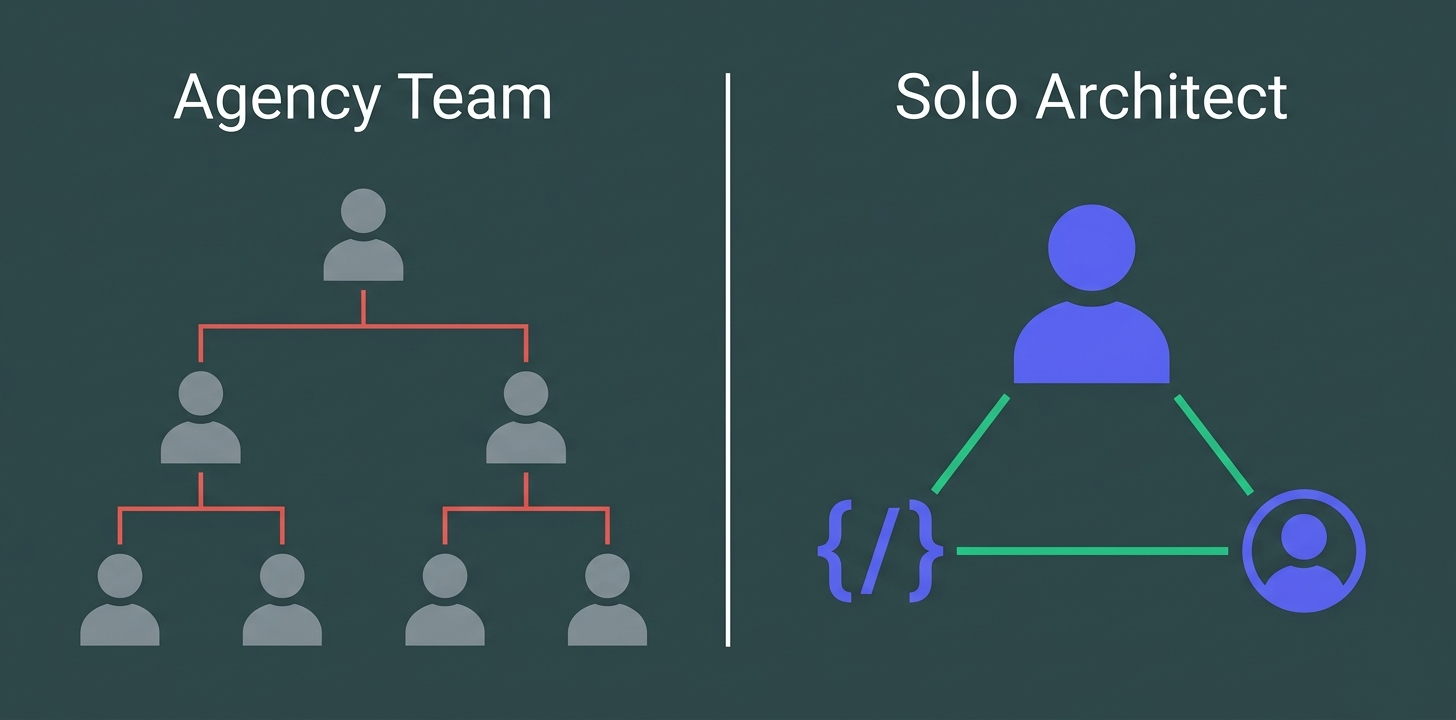
The solo architect model eliminates every structural problem in the agency model:
| Agency Problem | Solo Architect Solution |
|---|---|
| Communication layers | You talk directly to the person writing your code |
| Misaligned incentives | Project-based pricing — architect profits from efficiency |
| Fragmented ownership | One person owns the entire architecture |
| Template-driven code | Custom-engineered for your specific requirements |
| Knowledge loss on rotation | Zero rotation — same person from day one to deployment |
| Vendor lock-in | You own 100% of the code, deployed on standard infrastructure |
The trade-off is transparency: A solo architect will tell you “this project needs 8 weeks” and mean it — because there is nobody to hide behind. An agency will tell you “6 weeks” knowing they have change orders built into their forecast.
How Should a Founder Choose Their Development Partner?
Whether you choose an agency, a solo architect, or a freelancer — use this framework to evaluate before signing:
The 8-Point Evaluation Checklist
| # | Question | Red Flag | Green Flag |
|---|---|---|---|
| 1 | Who will write my code? | ”Our team will be assigned after signing” | Specific person identified with their portfolio |
| 2 | Can I talk to the developer directly? | ”All communication goes through your PM” | Direct access guaranteed |
| 3 | Do I own the source code? | ”Code is licensed to you” or vague ownership terms | Full ownership transfer in contract |
| 4 | What happens if we part ways? | ”We host your application on our infrastructure” | Standard deployment, full documentation |
| 5 | How do you handle scope changes? | ”Change orders require new quotes and approval cycles” | Flexible iteration within agreed parameters |
| 6 | Can I see a similar project you built? | Generic portfolio with logos only | Live applications you can test |
| 7 | What is your testing process? | ”QA reviews before delivery” | Automated tests written during development |
| 8 | How do you handle post-launch bugs? | ”Support packages available for purchase” | Warranty period included |
If any answer falls in the red flag column, walk away. These are not negotiable points — they are indicators of how the engagement will unfold.
The Questions Most Founders Forget to Ask
Beyond the checklist, ask these three questions that reveal more than any portfolio:
“Show me the worst project you delivered and what went wrong.”
Any honest partner has a failure story. How they handled it tells you everything about their accountability and problem-solving process. If they claim every project was perfect, they are lying.
“What would you tell me NOT to build?”
A partner who agrees with every feature request is optimizing for billing, not for your product. A good architect will push back on unnecessary complexity and save you money.
“If you disappeared tomorrow, could another developer take over my project within a week?”
This tests for clean code practices, documentation, and standard infrastructure. If the answer is hesitant, you are building vendor dependency.
Talk directly to the architect →
Frequently Asked Questions
Are all agencies bad for startups?
No. Some agencies specialize in early-stage startups and structure their teams accordingly — small pods of 2–3 senior engineers with direct client access. The problems described in this article apply to the traditional agency model with large teams, project managers, and hierarchical communication. If an agency offers direct developer access and full code ownership, evaluate them on their merits.
What if my project is too large for one person?
Legitimate concern. A solo architect is ideal for MVP through production-scale applications. For enterprise platforms requiring multiple engineers working simultaneously on different systems, a small focused team (2–4 senior engineers) outperforms both a solo architect and a large agency. The key is senior engineers with direct communication — not junior developers managed by layers of project managers.
How do I know if a solo architect is actually senior enough?
Ask to see production applications they have built and deployed. Not mockups, not designs — live, running systems handling real users. Ask about their architecture decisions and why they chose specific technologies. A senior architect explains trade-offs. A junior developer explains features.
What if my solo architect gets sick or becomes unavailable?
This is the most common objection — and it applies equally to agencies. When a key developer leaves an agency mid-project, the replacement needs the same ramp-up time. The mitigation is the same in both models: clean code, documentation, standard infrastructure, and full code ownership. If these are in place, any competent engineer can continue the work.
Should I hire a full-time CTO instead?
For a first product build, hiring a CTO is premature. A full-time CTO costs $120,000–$200,000+ annually and needs a team to manage. At the pre-seed and seed stage, contract a senior architect to build your first product, then hire a CTO when you need ongoing technical leadership — not just a codebase.
How do I transition from an agency to a solo architect mid-project?
First, ensure you have full access to your source code repository, deployment credentials, and documentation. Then engage the solo architect for a codebase audit before committing to continuing development. If the existing code is clean and well-structured, the transition is smooth. If it is poorly architected — which is common with agency builds — a partial or full rebuild may be more cost-effective than patching bad architecture.