 Omar Fouda
Table of Contents
- Which home builder marketing ideas actually sell homes?
- 1. Give every community its own page
- 2. Add an interactive site plan
- 3. Give quick move-in homes their own page
- 4. Film a video tour of every model
- 5. A Google Business Profile per sales center
- 6. Ask every new homeowner for a review
- 7. Make your broker co-op program easy to find
- 8. Hold events with a reason to come
- 9. Build a VIP list before each release
- 10. Answer fast, and name the home
- 11. Keep following up by email for months
- 12. Retarget site visitors within housing ad rules
- 13. Put the site plan on the sales center screen
- 14. Put QR codes on lot signs
- Which idea should you start with?
- How to get an interactive site plan
- See It Live: Alton, Florida
- Frequently Asked Questions
Which home builder marketing ideas actually sell homes?
The ideas worth your budget help a buyer find a specific home or lot, trust you enough to visit, or come back when ready. Each idea below has why it works and a way to start this month, with the official source linked wherever a rule applies.
One idea on the list is what we build: an interactive site plan. FoudaTech maps every home or lot in a community, so buyers can tap one for its details and send an inquiry that names it. Small communities start from US$2,000 setup + US$600/year; larger communities and builders with several communities are quoted after a free demo. The live Alton map covers 931 homes in Palm Beach Gardens, Florida, and went live on the team’s own website nine days after their first email. Get a free demo of your community →
1. Give every community its own page
Why it works: Buyers search by community name and by area. A full page per community gives them, and Google, one place for the price range, models, available homes, amenities, location and sales center hours. A row in a list of communities gives them much less to go on.
Start this month: Open each community page on your phone. Check that it has prices (or a range), models, what’s available now, a site plan, directions, hours and one clear way to get in touch. Fix your busiest community first.
2. Add an interactive site plan
Why it works: Your buyer chooses a home and a lot together. A clickable site plan on the community page lets them see what’s left, tap a lot for its model, size and floor plan, and send an inquiry that names it, at any hour. The map shows the status your team sets by hand in a dashboard, so update it the day a lot is reserved.
Start this month: Send your busiest community’s site plan and lot list for a free demo. Comparing vendors? Use our site plan software checklist; for lot-and-model fit, see interactive lot maps for home builders.
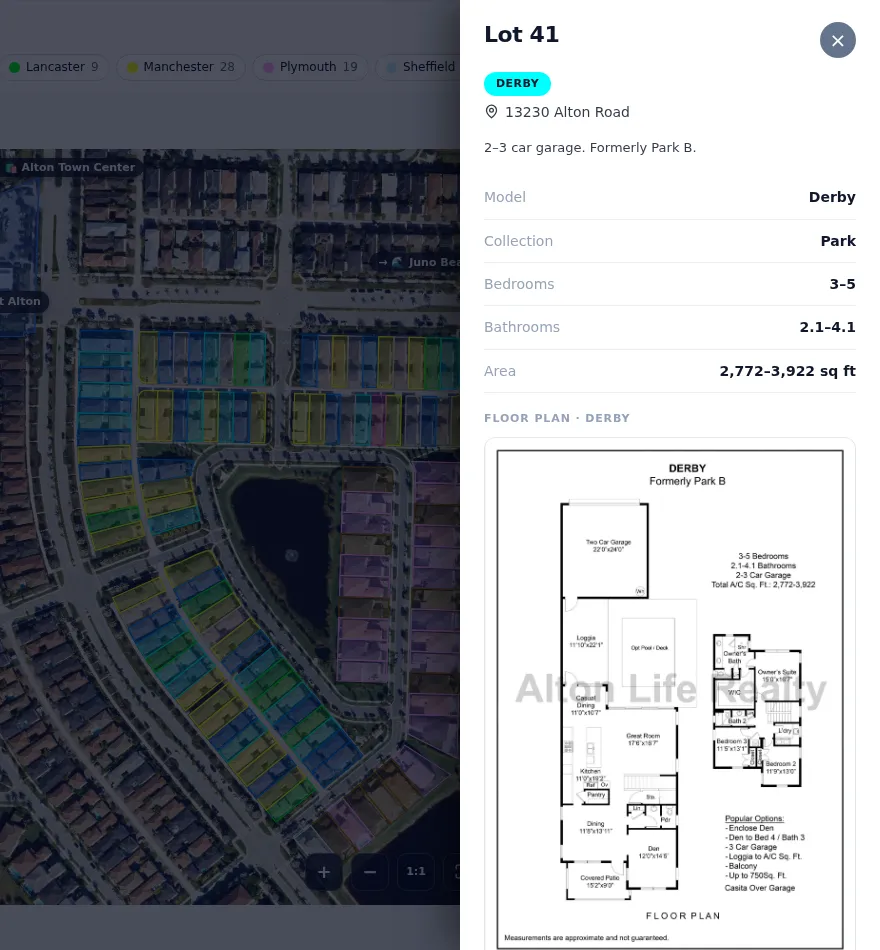 One home on the live Alton map we built for Alton Life Realty in Palm Beach Gardens, FL: model, address, bedrooms, bathrooms, size and floor plan.
3. Give quick move-in homes their own page
Why it works: Some buyers can’t wait for a build: a job move, a lease ending, a home already sold. For them, a quick move-in home with a completion date is the product, and it’s easy to miss when it’s buried in a community page.
Start this month: List every quick move-in home on one page with its address or lot, model, beds, baths, square feet, estimated completion month, photos and price, linked to its community page. Update the page weekly, and take homes off the day they sell.
4. Film a video tour of every model
Why it works: Video lets an out-of-town buyer, or a partner who missed the visit, walk the home before driving out, and it answers layout questions a floor plan can’t.
Start this month: Film one model on a phone with a stabilizer, with a salesperson narrating the route a buyer would walk. Post it on YouTube and the model’s page; add a 3D virtual tour later. For aerial footage, hire a pilot with an FAA Remote Pilot Certificate: the FAA’s Part 107 rules cover flying a small drone for work or business (FAA).
5. A Google Business Profile per sales center
Why it works: A profile puts a sales center on Google Maps and Search with its hours, directions, photos and reviews.
The rules matter. Google’s eligibility guidelines say a business must make in-person contact with customers during its stated hours, and they list for-sale properties such as model homes as ineligible, while sales or leasing offices are eligible (Google). The name should be your real-world name as used on your signage, with no more than one profile per location (Google).
Start this month: List the sales centers that are staffed during posted hours and have permanent signage. Claim or create one profile for each, with the name on the sign, the real hours and the community page as the website.
6. Ask every new homeowner for a review
Why it works: Buyers check a builder’s reviews before committing to something this big.
Follow the rules. Google prohibits offering incentives for reviews (Google), and its content policy doesn’t allow selectively asking happy customers, or reviews based on a conflict of interest such as employment (Google). The FTC’s consumer review rule, in effect since October 21, 2024, bans buying positive or negative reviews and certain undisclosed insider reviews (Federal Register).
Start this month: Email every buyer a direct review link a few weeks after move-in, not at the closing table; Google says not to pressure people to review while they’re on your premises. Reply to every review.
7. Make your broker co-op program easy to find
Why it works: Agents bring buyers to communities whose terms they know. Since August 17, 2024, offers of compensation are no longer allowed on MLS platforms, though sellers can still offer compensation off an MLS (NAR). Your own website is a natural place for your program.
Start this month: Publish a “For agents” page with your co-op terms, registration rule, current incentives, the community map link and a contact who answers. Have your attorney or broker review it.
8. Hold events with a reason to come
Why it works: An event gives a buyer a date and a reason to visit now rather than “some weekend”: a phase release preview, a model grand opening, an agent lunch, or a first-time buyer evening with your lender partner.
Start this month: Book one event for next month. Invite your interest list and local agents, and plan the follow-up before the day: who contacts whom, and by when.
9. Build a VIP list before each release
Why it works: People who asked to hear about the next phase become your first appointments, and their answers tell you which lot types and price ranges they want before you set prices. Our guide on how to sell lots faster in a new subdivision covers release planning.
Start this month: Add a sign-up form to the next phase’s page that asks for timing, lot preference and price range, and email the list before the public release. Under the federal CAN-SPAM Act, marketing emails need a clear way to opt out and your valid postal address, and opt-outs must be honored within 10 business days (15 U.S.C. 7704).
10. Answer fast, and name the home
Why it works: A buyer who sends an inquiry may be comparing several communities that week. A quick, specific reply (“Lot 14 is still available, here are the two plans that fit, and I can walk it with you Saturday”) gives them a reason to visit you first.
Start this month: Give every inquiry one owner and a same-business-day rule. Write templates for available, reserved and sold, each ending with a next step. Inquiries from our map name the lot or home, which makes the specific reply easy.
11. Keep following up by email for months
Why it works: Plenty of buyers aren’t ready after the first visit; they may be waiting on a home sale, a lease or a rate. Useful emails keep you in mind without a sales call: a new release, a quick move-in home nearing completion, a change on a lot they asked about.
Start this month: Write five emails once: a thank-you with the map link, the models they saw, a quick move-in update, a release announcement and a “still looking?” note. Send them over the following months, and honor opt-outs (see idea 9).
12. Retarget site visitors within housing ad rules
Why it works: Visitors who left without an inquiry can see your community, quick move-in homes or next release again.
Housing ads have their own rules. In the US and Canada, Google Ads doesn’t allow housing ads to target by gender, age, parental status, marital status or ZIP code, while radius, city and country targeting are allowed (Google Ads). Remarketing lists are restricted only if they’re built using those signals (Google Ads FAQ). Meta has separate audience rules for housing ads (Meta).
Start this month: Tag every community and quick move-in page, build a visitor audience, and run one ad per community. If an ad names a rate or payment, have your lender check it against Regulation Z (CFPB).
13. Put the site plan on the sales center screen
Why it works: The map buyers use at home can run on a TV or tablet in the sales center, so the walk-through, the website and the link you text afterwards show the same lots. When a consultant marks a lot Reserved in the dashboard, all three show it.
Start this month: Open the community map full screen on the sales center TV and walk one buyer through it: the whole community, one filter, one lot, its floor plan. Our guide to an interactive site plan in your new home sales center covers screens, Wi-Fi and who updates status.
14. Put QR codes on lot signs
Why it works: Buyers drive through in the evening and at weekends, when the sales center may be closed. A QR code on a lot sign or a model’s front sign opens the map on their phone, so they can check status and inquire from the curb.
Start this month: Add a QR code to your next sign order, pointing to the community map with a tracking parameter so you can count visits from signs. Check local sign rules and HOA conditions first.
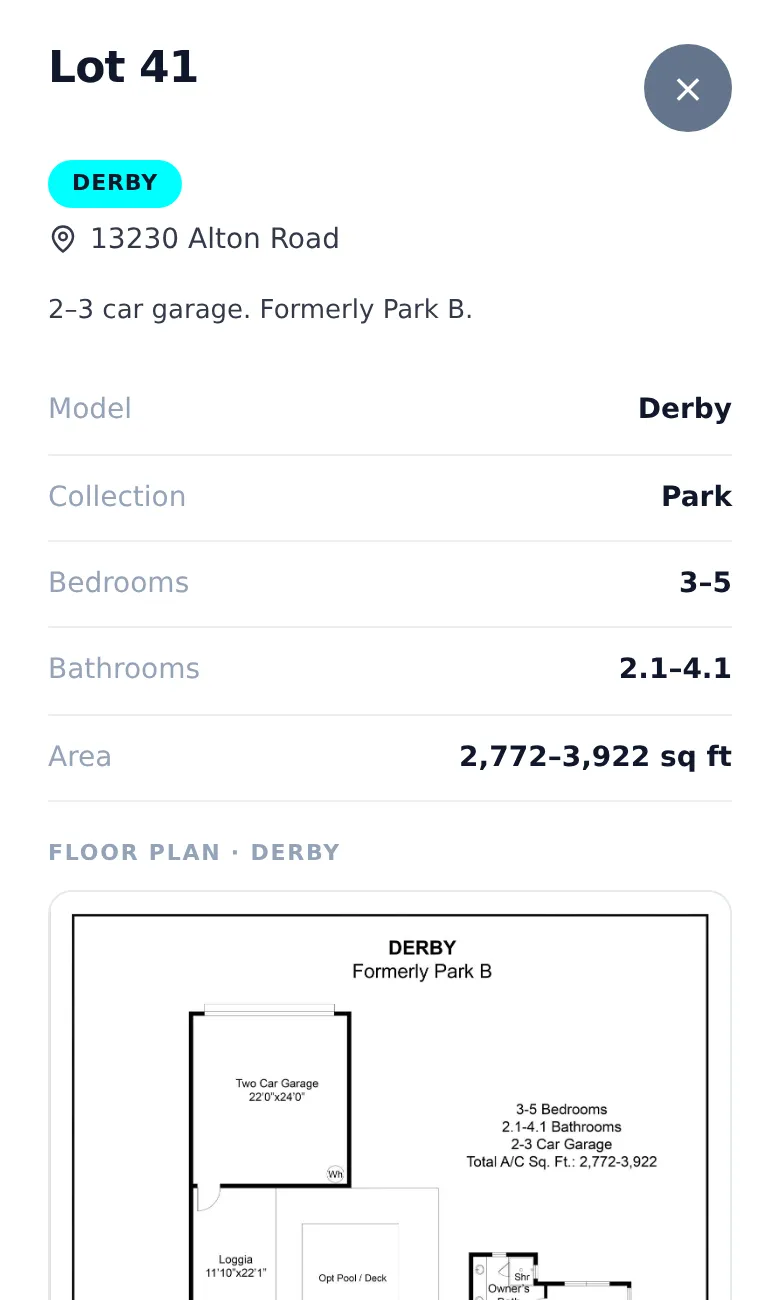 One home on the live Alton map we built for Alton Life Realty in Palm Beach Gardens, FL, on a phone.
Which idea should you start with?
| If this is your problem | Start with ideas |
|---|---|
| Website visits, but few inquiries | 2, 3 and 10 |
| Inquiries, but few visits | 10, 11 and 8 |
| Few buyers come through agents | 7 and 8 |
| A new phase is coming | 9, 8 and 2 |
| Drive-by traffic, but no calls | 14 and 5 |
| Lots sit after the best ones sell | How to sell lots faster |
How to get an interactive site plan
FoudaTech builds it for you with Tower Maps. Send a site plan and lot list (a spreadsheet is fine), and we build one section or phase as a free demo, usually within a few days. The system is already running, so once we have everything (site plan or aerial, lot list, floor plans, photos), your map can be live in 2 to 3 days; larger communities take longer. It embeds with one script tag or an iframe, or works as a link. In a Lighthouse test on 29 November 2026, it showed in about 1.5 seconds on desktop and about 4 seconds on a slow phone connection, with no page jumping.
Pricing (USD): from $2,000 setup + $600/year for a small community; larger communities and builders with several communities are quoted after a free demo. New projects are paid 50% to start, 30% once you’ve tested the working map and 20% at launch.
See the live map on our community maps page → or request a free demo.
See It Live: Alton, Florida
Alton, in Palm Beach Gardens, Florida, has 931 homes in four neighborhoods and 17 home models. We built its map for Alton Life Realty, a real estate team that focuses on Alton and found FoudaTech through this blog. Every home is outlined on 2025 aerial imagery and colored by model, with one tap for its address, model, bedrooms, bathrooms, square feet and floor plan. Alton is built out, so the map shows homes, not lot status or prices. The full map went live on the team’s website, with one line of code, nine days after their first email. Open the live Alton map or read the case study.
Frequently Asked Questions
What are the best marketing ideas for home builders?
The ones that help a buyer pick a specific home or lot and get in touch: a full page per community, an interactive site plan, a quick move-in homes page, fast replies, and a broker program agents can find.
Can a model home have its own Google Business Profile?
Google’s guidelines list model homes as ineligible, while sales or leasing offices are eligible, and a business must make in-person contact with customers during its stated hours. Create profiles for staffed sales centers.
Can builders still offer co-op to buyer agents?
Yes. NAR says that since August 17, 2024, offers of compensation are no longer allowed on MLS platforms, but sellers can still offer compensation off an MLS. Your own website is a natural place to publish your program.
Can we give buyers a gift for leaving a review?
Not for Google reviews: Google prohibits offering incentives in exchange for reviews, and the FTC’s rule bans buying positive or negative reviews. Ask every buyer, and make it easy with a direct link.
How much does an interactive site plan cost?
At FoudaTech, from US$2,000 setup plus US$600 a year for a small community. Larger communities are quoted after a free demo.