 Omar Fouda
Table of Contents
- Why lots sell slowly
- How should you price lot premiums?
- Should you release lots in phases?
- Builder and broker programs
- How should lot holds and deposits work?
- Signs, sales trailers and model homes
- Show buyers which lots are left
- Should you build spec homes on key lots?
- Financing and incentives that move lots
- How fast should you answer a lot inquiry?
- Worked example: a 90-lot subdivision
- How to get an interactive lot map
- See It Live: Alton, Florida
- Frequently Asked Questions
Why lots sell slowly
Lots rarely sit for one big reason. It’s usually a few small ones, and most cost little to fix. Find yours in the first column:
| What you see | Likely cause | Start with |
|---|---|---|
| Page visits, few inquiries | Buyers can’t see what’s left or what it costs | Showing which lots are left |
| Inquiries, few holds | No clear next step, slow replies | Holds and fast follow-up |
| Premium lots sit | Premium too high, or the reason isn’t shown | Pricing and premiums |
| Standard lots sit once the best ones sell | Every premium lot went out first | Phase releases |
| Few buyers come through agents | Co-op terms are hard to find | Broker programs |
| Buyers can’t picture a home on the lot | Nothing is built yet | Spec homes |
One of these tactics is what we build. FoudaTech turns your plat into an interactive lot map: buyers tap a lot to see its status, size, features and price (if you publish prices), and send an inquiry that names the lot. Small communities start from US$2,000 setup + US$600/year; larger ones are quoted after a free demo of one phase. It runs on the same map system as the live Alton map, 931 homes in Palm Beach Gardens, Florida, which went live on the team’s own website nine days after their first email. Send your plat for a free demo →
How should you price lot premiums?
Set a base price for a standard interior lot, then add premiums for what buyers will pay more for: a corner, a pond or preserve view, a cul-de-sac, extra size or a walkout. Three or four premium tiers are easier to explain than a different number on every lot.
- Price what the buyer can see. “Backs onto the pond” is a premium buyers understand; “better lot” isn’t. Name the feature on the lot and show a photo of the view.
- Watch the premium lots. If pond lots get inquiries but no holds while standard lots sell, the premium is the likely problem, not the community.
- Change prices at a release, not mid-week, and tell the agents you work with.
- Decide whether to publish prices. Published prices let buyers rule themselves in or out before they call. Hidden prices start conversations, but lose the buyers who won’t ask.
Our maps show or hide prices across the whole map. See how premiums look on a map in interactive plat maps.
Should you release lots in phases?
Usually, yes. A release that won’t last gives buyers a reason to decide, lets you test prices before the whole subdivision is committed, and keeps your team focused.
- Mix lot types in every release. If every pond and preserve lot goes out first, later releases look like leftovers.
- Hold back a few good lots on purpose, so the next release has something to talk about.
- Be honest about it. A held-back lot isn’t Reserved or Sold, so never label it that way to suggest demand. Leave it off the map until it’s released, or say plainly that it comes later.
- Release to your interest list first, even a day before the public.
Builders selling house-and-lot packages also need to show which models fit each lot; see interactive lot maps for home builders.
Builder and broker programs
If you sell lots to builders, write the program down: which lots are open to builders, how they reserve and take down lots, the deposit, and the design rules. Give every builder the same map link, so nobody works from an old PDF.
If you work with agents, make your co-op terms easy to find. Since August 17, 2024, under the National Association of REALTORS® settlement, offers of compensation are no longer allowed on MLS platforms, though sellers can still offer compensation off an MLS. Agents who use an MLS also need a written agreement with a buyer before touring a home (NAR). So:
- Publish your broker program on your own website: what you offer, your registration rule and who to contact.
- Send agents the same map link, so they can check status before bringing a client.
- Hold an agent preview before each release.
This isn’t legal advice; have your attorney or broker review the terms.
How should lot holds and deposits work?
A hold without rules turns into a lot nobody can buy. Write a one-page policy: how long a hold lasts, what it takes (a signed reservation, a deposit or both), whether the deposit is refundable, and who can place and release holds, so two salespeople never promise the same lot.
When a deposit comes in, whoever took it marks the lot Reserved in the map’s dashboard. The map itself takes no deposits and doesn’t lock lots.
If you sell vacant lots to consumers, ask your attorney whether the Interstate Land Sales Full Disclosure Act applies. The CFPB says it requires a developer of a subdivision with 100 or more nonexempt lots to register the subdivision and give buyers a property report before a sales contract is signed (CFPB). There are exemptions, and state rules may apply too.
Signs, sales trailers and model homes
Some buyers find a subdivision by driving past it when nobody is on site. Make that drive count:
- Entrance and directional signs that say what’s for sale.
- A sign on every available lot with its number and a QR code that opens your lot map, so buyers can check status and inquire from the curb.
- A sales trailer with posted hours, staffed during them, and a way to reach someone when it isn’t.
- A model or finished home if you can manage one.
Check local sign rules and HOA conditions first. For the map on a trailer screen, see a site plan in your sales center.
Show buyers which lots are left
Before calling, a lot buyer wants to know which lots are left, how big they are and what they cost. A PDF plat with shaded lots answers that badly, and only as of the last export.
An interactive lot map answers it on the buyer’s phone. Each lot opens its status (Available, Reserved or Sold), size, frontage, the reason for any premium, the price if you publish it, and a one-tap inquiry that names the lot. Views and filters narrow a large subdivision to one phase or lot type.
Tell your team plainly: the map shows the status your team sets. Salespeople change each lot by hand in the dashboard. Nothing syncs with an MLS or CRM, and nothing locks a lot automatically. Update a lot the day its deposit comes in, and the map stays honest.
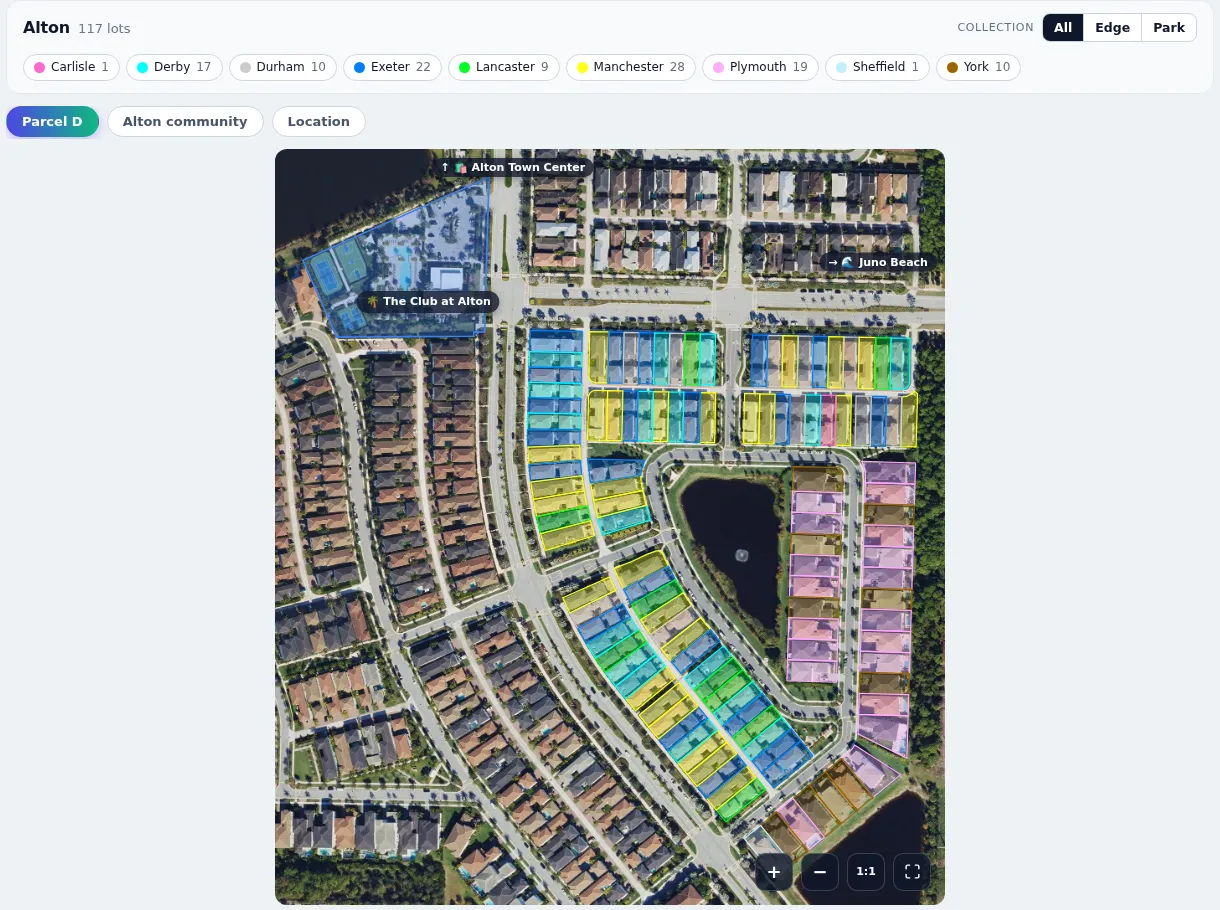 One neighborhood of the live Alton map we built for Alton Life Realty in Palm Beach Gardens, FL: 117 homes colored by model. Alton is built out, so the map shows homes, not lot status or prices; a lot map on the same map system adds those.
Should you build spec homes on key lots?
A spec home, built before it has a buyer, can sell more than itself. It shows what a finished home looks like on your lots, gives agents something to tour, and suits buyers who must move by a date. Put it where every visitor drives past, on a lot type you need to move. The risk is carrying cost, so start with one or two and market each from the day the foundation goes in. Developers can offer a builder partner a well-placed lot for a spec or model home.
Financing and incentives that move lots
Aim incentives at a problem, such as the lots that sit, or tie them to a deadline, such as the end of a release, instead of spreading them across the community:
- Closing cost help for buyers who close by a set date.
- A rate buydown or other lender incentive, arranged with a lender you work with.
- Lenders who make lot and construction loans, for buyers who want to build later.
- An upgrade package or premium credit on specific slow lots.
The right amount depends on your market and lender, so we don’t quote numbers. Put each incentive’s terms and end date in writing.
Check financing ads, too. Under Regulation Z, an ad that states a rate must give it as an annual percentage rate (APR), and an ad that mentions a down payment, the number of payments or repayment period, a payment amount or a finance charge must also state the down payment, repayment terms and APR (12 CFR 1026.24). The CFPB’s official commentary says this applies to home builders who advertise credit, even though they aren’t lenders (comment 2(a)(2)-2).
How fast should you answer a lot inquiry?
The same business day, and within the hour if you can. A buyer asking about your lots on a Saturday evening may be asking two other communities too.
- Answer the lot they asked about. Every inquiry from our map names its lot, so one reply can give its status, size, price and a time to walk it.
- Keep templates for available, reserved and sold (with two similar lots to suggest).
- Give each inquiry one owner, and end every reply with a next step.
For more follow-up ideas, see home builder marketing ideas.
Worked example: a 90-lot subdivision
A made-up example to show the method. It isn’t a real project or client.
A developer has 90 lots in three phases of 30. Phase 1 has 18 standard lots, 6 pond lots, 4 corners and 2 cul-de-sac lots.
| When | Step | What happens |
|---|---|---|
| 6 weeks before | Interest list | Entrance sign, plus a sign-up form asking for timing and lot preference |
| 2 weeks before | Agent preview | Agents walk the site and get the map link and written co-op terms |
| Release day | First release | 26 lots: all standard and cul-de-sac lots, 4 pond lots, 2 corners. The list gets first appointments |
| From release day | Holds | Signed reservation plus deposit; the lot is marked Reserved that day |
| 2 weeks in | Review | Lots with inquiries but no holds get new premiums at the next release, or a spec home |
| When most of the 26 are held | Second release | The 2 held-back pond lots and 2 corners go on the map |
The held-back lots are real inventory, added when they’re released and never shown as Reserved or Sold to fake demand.
How to get an interactive lot map
FoudaTech builds the map for you with Tower Maps, on your own plat or aerial:
- Send your plat and a lot list (a spreadsheet is fine).
- We map one phase as a free demo, usually within a few days.
- We build the full map. The system is already running, so once we have everything (plat or aerial, lot list, floor plans if you sell home plans, photos), it can be live in 2 to 3 days. Larger communities take longer.
- You add it to your site with one script tag or an iframe, or share it as a link.
Pricing (USD): from $2,000 setup + $600/year for a small community; larger ones are quoted after the free demo. New projects are paid 50% to start, 30% once you’ve tested the working map and 20% at launch. For what moves the price, see interactive site plan cost.
Request a free demo of one phase →
See It Live: Alton, Florida
Alton, in Palm Beach Gardens, Florida, has 931 homes in four neighborhoods and 17 home models. We built its map for Alton Life Realty, a real estate team that focuses on Alton: every home outlined on 2025 aerial imagery and colored by model, with one tap for its address, model, bedrooms, bathrooms, square feet and floor plan. Alton is built out, so its map shows homes, not lot status, prices or phases. The team saw a free demo of one neighborhood the day after their first email, and the full map went live on their own website nine days after that email. Open the live Alton map or read how we built it.
Frequently Asked Questions
What is the fastest way to sell lots in a new subdivision?
Fix what stops buyers first: show which lots are left and what they cost, explain premiums, keep holds simple and answer inquiries the same business day. Then fill each release with an interest list and an agent program.
How do you price premium lots?
Add a few premium tiers to a base lot price for features such as a corner, a pond or preserve view or a cul-de-sac. Show the reason on each lot, and adjust at the next release if premium lots get inquiries but no holds.
Should we hold back lots from a release?
Holding back a few good lots keeps later releases attractive. Say plainly that they come later, and never mark them Reserved or Sold to suggest demand.
Can an interactive lot map take deposits or hold lots?
No. Our map takes no reservations or payments, doesn’t lock a lot and doesn’t sync with an MLS or CRM. Buyers send an inquiry that names the lot; your team takes the deposit and marks the lot Reserved in the dashboard.
How much does an interactive lot map cost?
From US$2,000 setup plus US$600 a year for a small community. Larger communities are quoted after a free demo of one phase.