 Omar Fouda
Table of Contents
- The short answer
- What drives interactive site plan cost
- Setup fee vs annual subscription
- How we price an interactive site plan
- Three example communities
- Hidden costs to ask every vendor about
- How to get one
- See It Live: Alton, Florida
- Frequently Asked Questions
The short answer
Interactive site plan cost for a home community usually comes in two parts: a setup fee to map your lots and load your data, and an annual subscription to keep the map hosted, editable and supported while you sell. At FoudaTech that starts at $2,000 setup plus $600 a year (USD) for a small community, and is quoted by the number of lots, views, phases and models.
If you are a builder, developer or broker pricing a clickable site plan for a subdivision or master-planned community, you have probably noticed that quotes are hard to compare. Vendors bundle different things into each part. This guide explains what actually moves the price for a community of 50 to 1,000+ lots, and what to ask so the quotes line up.
Selling condos instead of lots? The vertical version of this guide is how much an interactive tower map costs.
Want your own number? Send your site plan and we’ll build a free demo of your community and quote it: request a free demo →. Or see a finished one first: the live Alton map covers 931 homes in Palm Beach Gardens, Florida, and went live on the team’s own website nine days after their first email.
What drives interactive site plan cost
Most of the work in a community map is not the software. It is tracing every lot accurately and connecting each one to the right data. These are the factors that change how much of that work there is.
Number of lots
Every lot is a shape traced onto your image and a record in the dashboard. A 60-lot infill community and a 900-lot master-planned community are very different jobs. More lots means more tracing, more data to check, and more thought about filters, so a buyer can narrow hundreds of homesites to the handful that fit them.
Number of neighborhoods and views
A small community often needs one view. A large one usually needs several: one tab for the whole community, one per neighborhood or village, and sometimes a location view showing where the community sits. Each view is its own mapped image with its own lots, and buyers need to move between them without getting lost. The number of views is often a bigger cost driver than the raw lot count.
Whether a sharp aerial or site plan already exists
The map is built on an image you already have: a site plan, a plat, an aerial photo or a rendered community map. If it is sharp enough that each lot line is clear, there is nothing new to produce. If your only image is a blurry PDF export, or the community is still raw land with no usable aerial, someone has to produce a clean image first, such as your land planner, a drone photographer or a renderer. That is a separate cost from the map. Ask every vendor whether their price assumes you supply the image.
Number of models and floor plans
Builders sell a lot and a home together, so each lot usually shows the models that fit it, each with a floor plan. Ten models across three collections is more setup than three models. Coloring lots by model, with a key showing how many of each, also depends on clean model data for every lot. We cover the lot-and-model question in detail in interactive lot maps for home builders.
Amenity pins and galleries
Pins for the clubhouse, pool, town center, trails or sales center help buyers judge where a lot sits. A few pins are quick. Per-amenity photo galleries, and per-lot or per-model galleries, take more time because every image has to be matched and prepared for the web. For communities that sell on lifestyle, such as 55+ active adult communities, amenity content is often worth the extra setup.
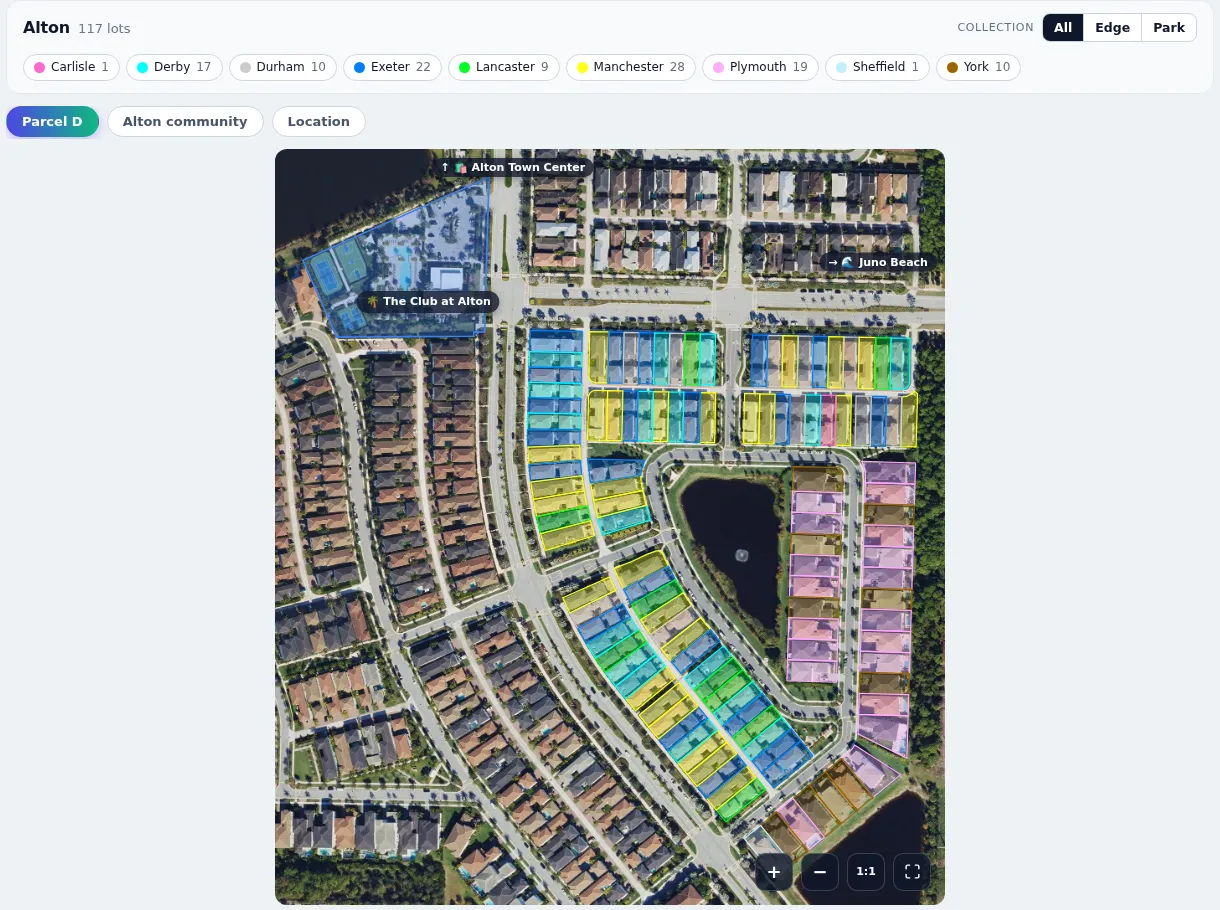 One neighborhood (117 homes) of the live Alton map we built for Alton Life Realty in Palm Beach Gardens, FL, colored by home model, with pins for the clubhouse and town center. The full map covers all 931 homes. Open the live map.
Setup fee vs annual subscription
The two parts of an interactive site plan cost pay for different things. Knowing which is which makes it easier to spot a quote that looks cheap now and costs more later.
| Setup fee (one-time) | Annual subscription | |
|---|---|---|
| What it pays for | Building your community map | Keeping it live and current |
| Typical work | Tracing every lot, building views and tabs, loading lot and model data, amenity pins, testing on phones | Hosting, the management dashboard, updates, support and edits |
| When you pay | Before launch | Each year the map is live |
| What changes it | Lots, views, models, galleries, branding | Size of the community and support needed |
The subscription is what keeps the map useful. Lots go under contract, phases release, premiums change. If every change means emailing a developer and waiting, the map goes out of date and buyers stop trusting it. A dashboard your own team controls, with edits included, is what keeps lot availability accurate.
How we price an interactive site plan
All prices are in USD.
- Small community (one site plan view, a few models): from $2,000 setup plus $600 a year.
- Larger communities (several neighborhoods, phases, many models, amenity pins) and builders with several communities: quoted from your site plan and lot list, because every lot is mapped by hand and the work grows with the size of the plan.
What every plan includes: the interactive map, a management dashboard your team controls, hosting, inquiries delivered to you, updates, support and unlimited edits. Billing for the subscription is annual. The setup fee is paid 50% to start, 30% once you’ve seen and tested the working version, and 20% at launch.
Three example communities
These are illustrations of how scope affects the price, not quotes or real projects.
A 60-lot infill community. One site plan view, three models, lot sizes, no galleries. A small community like this sits at the low end of the range. Builders who need lot status, premiums and the models that fit each lot get a quote from their plat after the free demo.
A 140-lot single-phase subdivision. One aerial view, two collections with eight models, a floor plan per model, photo galleries for each model, and pins for the pool and playground. The extra models, galleries and pins put it above the starting price.
A 900-lot master-planned community. A whole-community view, a tab for each of five neighborhoods, a location tab, a dozen models across three collections, amenity pins for the clubhouse and town center, and phases releasing over several years. A project like this is quoted individually, with multiple views, phases and dedicated onboarding.
Hidden costs to ask every vendor about
The quote is only part of the interactive site plan cost. These questions bring the rest into the open. Ask them of every vendor, including us.
Hosting and year two
Is hosting included, or do you need your own server or plan? What is the recurring fee in year two and after?
Edits and phase releases
Is releasing a new phase treated as an edit or as new work? Large communities sell over years, so this matters more for lots than for a single building. On our plans, edits are included, including adding phases as you release them.
Per-lot or per-update fees
Ask directly: “If we put twenty lots under contract this month, does it cost us anything to mark them?” The answer should be no. Also ask whether the price is per lot, because a per-lot price that looks small on a 60-lot community can be large on a 900-lot one.
Who updates lot status
Does your sales team update status from a dashboard, or do you send changes to the vendor and wait? If buyers can see a lot as available after it has gone under contract, they stop trusting the map.
New views and neighborhoods later
What does it cost to add a neighborhood tab, a new aerial after construction, or a new model after launch? Get the price for expansion before you sign.
The image
Does the quote assume you supply a usable aerial or site plan? If the vendor has to commission one, who owns it and what does it cost?
Branding and cancellation
Is the vendor’s logo on the map, and is removing it extra? What happens to the map and your data if you stop paying? We do not publish a cancellation policy on our site, so ask us, and any vendor, to confirm it in writing.
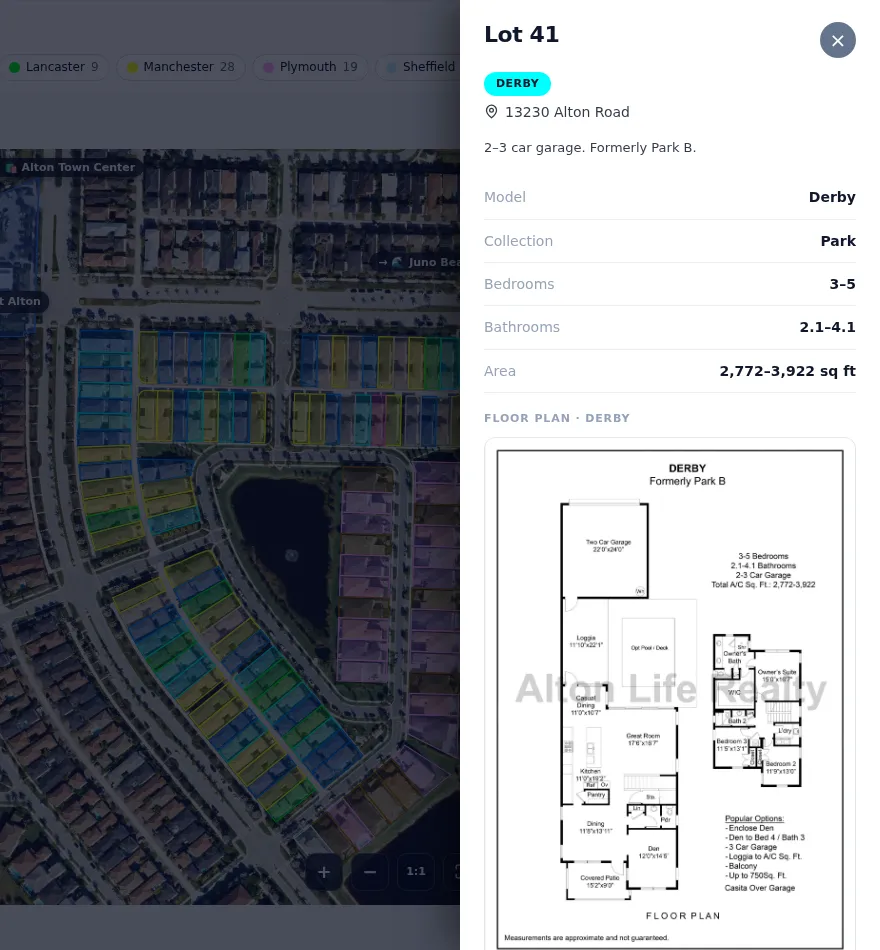 One home on the Alton map: model, address, bedrooms, bathrooms, size and floor plan.
How to get one
FoudaTech builds each community map for you with Tower Maps, on your own site plan or aerial. You do not configure a template yourself, and you do not need a new website.
- Send your site plan or aerial and a rough lot and model count, or request a free demo of your community.
- Send your lot data in a spreadsheet: lot number, phase, status, size, premium, and the models that fit.
- Send your model information: floor plans and photos for each model.
- We map every lot, build the views and amenity pins, and set up the dashboard.
- You embed it with one script tag on WordPress, Webflow or a custom site, or share it as a link with buyers and realtors. Brokers can see how that works for listings in interactive community maps for real estate agents.
Pricing (USD): from $2,000 setup + $600/year for a small community; larger communities and multi-community builders are quoted from the site plan and lot list. The subscription covers hosting, the dashboard, updates, support and edits.
The map system is already built and running, so your map can be live in 2–3 days once we have your site plan, lot list, floor plans and photos. Larger projects take longer, and we’ll tell you up front.
See a live community map with 931 homes → or request a free demo of your community.
See It Live: Alton, Florida
To see what a setup fee buys, here’s a finished project. Alton, in Palm Beach Gardens, Florida, has 931 homes in four neighborhoods, built in 17 home models. We built its map for Alton Life Realty, a real estate team that focuses on Alton. Every home is outlined on aerial imagery and colored by its model, a key counts the homes of each model, and one tap shows a home’s address, model, bedrooms, bathrooms, square feet and floor plan.
The team saw a free demo of one neighborhood the day after their first email, and the full map went live on their own website nine days after that email. Open the live Alton map or read how we built it.
Related guides: what an interactive site plan is, interactive plat maps, choosing site plan software, resort and hotel maps.
Frequently Asked Questions
How much does an interactive site plan cost for a home community?
At FoudaTech, from $2,000 setup plus $600 a year (USD) for a small community with one view. Larger communities are quoted from the site plan and lot list after a free demo, depending on lots, views, models and phases.
How is the setup fee paid?
In three parts: 50% to start, 30% once you’ve seen and tested the working version, and 20% at launch. The subscription is billed once a year.
What affects interactive site plan cost the most?
The number of lots and the number of views or neighborhoods, followed by how many models and floor plans you have and how much gallery and amenity content you want. Whether you already have a sharp aerial or site plan also matters.
Why is there an annual subscription?
The map has to stay live and accurate while you sell, often over several years. The subscription covers hosting, the dashboard, updates, support and edits, so your team can mark lots under contract and release phases without paying for each change.
Do I need a new aerial photo?
Usually not. A clear site plan, plat, aerial or rendered community map works as the base. If your only image is too blurry to see lot lines, a new one has to be produced first, and that is separate from the map.
Is releasing a new phase extra?
Not on our plans. Adding phases is covered by the edits included in the subscription. When comparing vendors, ask whether phase releases are included or quoted as new work.
How long does it take?
The map system is already built and running, so your map can be live in 2–3 days once we have your site plan, lot list, floor plans and photos. Larger projects take longer, and we’ll tell you up front. A free demo of one section of your community usually takes a few days.