 Omar Fouda
Farming a master-planned community means choosing one community and becoming the agent its owners think of first when they decide to sell. It’s slower than buying leads. But it builds on itself: every market update, event and closed sale makes the next listing easier to win, because owners can see you know their community better than anyone.
This playbook rests on one idea: give the community a home on your website that no portal can match, and point all your marketing at it. Alton Life Realty, a team that works one community in Palm Beach Gardens, Florida, did that with an interactive map of all 931 homes in Alton, where one tap shows any home’s model and floor plan. We built it, and it went live on the team’s own website nine days after their first email. Open the live Alton map. Community maps start from US$2,000 setup plus US$600 a year for a small community, and the first step is a free demo of one neighborhood of yours: request a free demo.
Table of Contents
- Why Farm a Master-Planned Community?
- How Do You Pick the Right Community?
- Learn Every Model and Every Neighborhood
- Build a Community Hub on Your Website
- Send Market Updates Owners Want to Read
- Use Events and the HOA Calendar
- Mail and Digital Touches
- Win the Listing Presentation
- How Do You Farm Without Breaking Fair Housing Rules?
- Make the Map the Anchor
- Frequently Asked Questions
Why Farm a Master-Planned Community?
A master-planned community makes a clean farm. It has a name people search for, a clear boundary, one HOA and shared amenities. Its homes were built in a set of models, so the closest comparable for a home is often the last one of the same model that sold. Know the models, neighborhoods and HOA better than anyone, and you can answer “what’s my home worth?” with something a generalist can’t: recent sales of their exact model, in their neighborhood.
How Do You Pick the Right Community?
Start with turnover: how many homes sell in a year compared with how many homes there are.
Turnover rate = closed sales in the last 12 months ÷ total homes in the community
The team at Realtors Property Resource (RPR) gives a rule of thumb in RISMedia: a farm should have at least a 5% turnover rate before you invest in it. Pull the closed sales from your MLS, and count the homes from the site plan or county records.
Here’s how two communities compare. Both are made-up examples, not real communities.
| Community A (example) | Community B (example) | |
|---|---|---|
| Homes | 900 | 350 |
| Closed sales, last 12 months | 54 | 10 |
| Turnover rate | 6.0% | 2.9% |
| Your listings a year if you win 1 sale in 10 | about 5 | 1 |
| Your listings a year if you win 1 sale in 4 | 13 to 14 | 2 to 3 |
Community A passes the 5% test. Community B would need a far bigger share to pay back the same marketing. Multiply the listing counts by your own average commission, then compare that with a year of spending on mail, events, ads and your website.
Then check:
- Who holds the listings now. RPR suggests looking at whether one agent already dominates. If no one does, there’s an opening.
- Price range and distance. You’ll need to serve these sellers well and be there often.
- New construction. If a builder still sells new homes inside the community, resale owners compete with them. Know both.
Finally, commit. The same RPR article recommends a mix of marketing, including email, social media and direct mail, over at least a one-year period.
Learn Every Model and Every Neighborhood
Start with a model sheet:
| Field | Why it matters |
|---|---|
| Model name and collection | Often how owners and buyers refer to a home |
| Beds, baths and square feet | A buyer’s first filter |
| Floor plan and its common options | What makes two homes of one model different |
| Neighborhoods it was built in | Where to find comparable sales |
| How many homes of that model exist | How rare it is |
The builder’s original brochures and plans, the HOA, county records and your own showings are the usual sources. Alton has 931 homes in four neighborhoods, built in 17 home models across the Edge, Park and Town collections. On its map, each model has its own color, and tapping a model lights up all of its homes. During the build, the team sent us a corrected floor plan for one model, the kind of detail only a specialist catches.
Learn each neighborhood the same way: its streets, lot types (lake, preserve, corner) and the walk to the clubhouse. And learn the HOA: the fees and what they cover, the rules buyers ask about, and how exterior changes get approved. Keep the HOA’s documents with their dates, and quote from them rather than from memory.
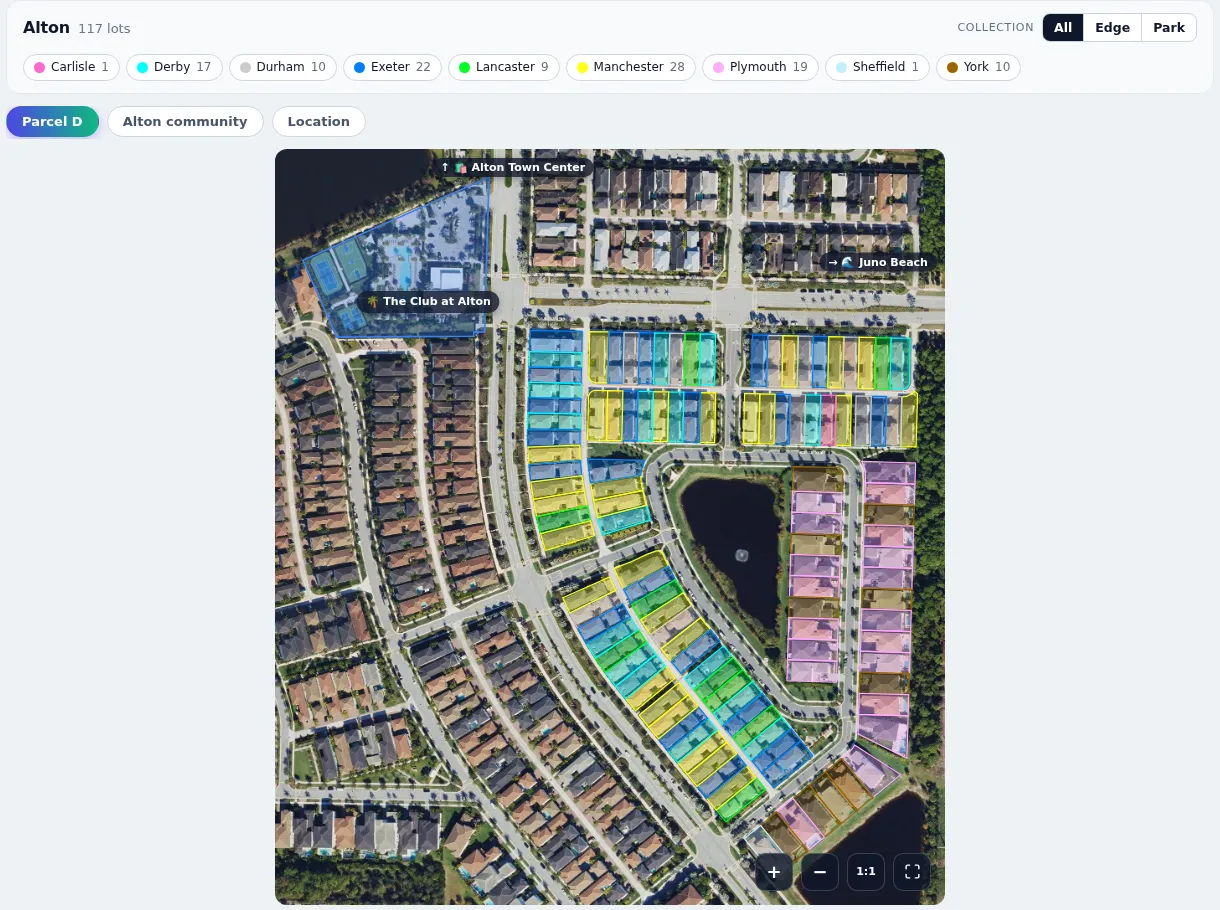 One neighborhood of the Alton map we built for Alton Life Realty in Palm Beach Gardens, FL: every home colored by its model, with a key that counts the homes of each model.
Build a Community Hub on Your Website
Your hub is the page you send everyone to. It should answer more questions about the community than any portal can:
- An interactive map of every home, with models and floor plans
- A short guide to each neighborhood
- Your model sheet
- The amenities, with your own photos
- HOA facts, each with a source and date
- The latest market update, with its date range and source
- Answers to common questions, and a short contact form
We cover the full outline in community pages that rank and get leads.
The map is what makes the hub hard to copy. A portal shows the homes for sale today. The map shows the whole community, so it’s useful to an owner who isn’t selling yet and to a buyer planning next year’s move. Alton’s map shows every home’s address, model, bedrooms, bathrooms, square feet and floor plan, plus The Club at Alton with the team’s photos and videos, Alton Town Center, and a location view toward Juno Beach. More in interactive community maps for real estate agents.
Send Market Updates Owners Want to Read
Owners want to know what homes like theirs are worth. Send a short update every month or quarter:
- Closed sales by neighborhood and by model, with price and days on market
- Homes for sale now and under contract
- One sentence on what changed
- A date range and source on every number, for example “Closed sales, Sep 1 to Nov 30, 2026. Source: [your MLS].”
- A link back to your hub for the full picture
Group sales by model, since that’s often the closest comparison, and follow your MLS’s rules on sharing its data.
If you send updates by email, the federal CAN-SPAM Act applies: every commercial email needs a clear way to opt out and your valid physical postal address, and opt-out requests must be honored within 10 business days (15 U.S.C. 7704).
Use Events and the HOA Calendar
Get the HOA’s calendar, from the annual meeting to amenity events and holidays, and time your touches around it. Sponsor or help with a community event if the HOA allows it, host a market talk for owners, and welcome new owners with a short guide to the community.
Read the HOA’s rules on signs, flyers, solicitation and booking amenities before you plan anything, and ask the management company when in doubt. Invite everyone in the same way.
Mail and Digital Touches
Here’s an example month to adapt:
| Week | Touch | What it says |
|---|---|---|
| 1 | Market update by model, linking to your hub | |
| 2 | Postcard | Recent sales, one community fact, a QR code to the map |
| 3 | Social post | A model of the month with its floor plan, or an amenity photo |
| 4 | In person | An event, an open house, or a note to a past client |
Mail. USPS Every Door Direct Mail (EDDM) delivers to every address on the carrier routes you choose, addressed to “Postal Customer”, so you don’t need a mailing list. EDDM Retail takes at least 200 and up to 5,000 pieces per day per ZIP Code, and USPS lists retail flats at $0.26 a piece as of November 2026. Check the route map so you know which streets each route covers.
The EDDM tool can also filter routes by age, income or household size. For real estate mail, skip those filters and mail every door in the community. HUD’s advertising rule covers choosing media or locations in a way that denies people housing information because of a protected characteristic such as race, religion or familial status (24 CFR 100.75).
Search ads. Google’s housing ad policy says that in the US you can’t target housing ads by age, gender, parental status, marital status or ZIP code. Radius targeting of at least 1 km and city targeting are allowed. A radius around the community, sending clicks to your hub, fits those rules.
Win the Listing Presentation
When an owner calls, bring what only a specialist has:
- Their home on the map, with its model and floor plan.
- Recent sales of the same model, then of the same neighborhood.
- How many homes of their model exist, and how many sold this year.
- What’s near their home: the walk to the clubhouse, the lake view, the corner lot.
- Your plan for buyers: the hub page, the map link you’ll send out-of-state buyers, and the floor plan in every listing.
On the same map system, you can mark your own listings with a status you set by hand in the dashboard. Alton’s map doesn’t do this; it covers the community itself. Follow your brokerage’s and your MLS’s rules before you show any sold information.
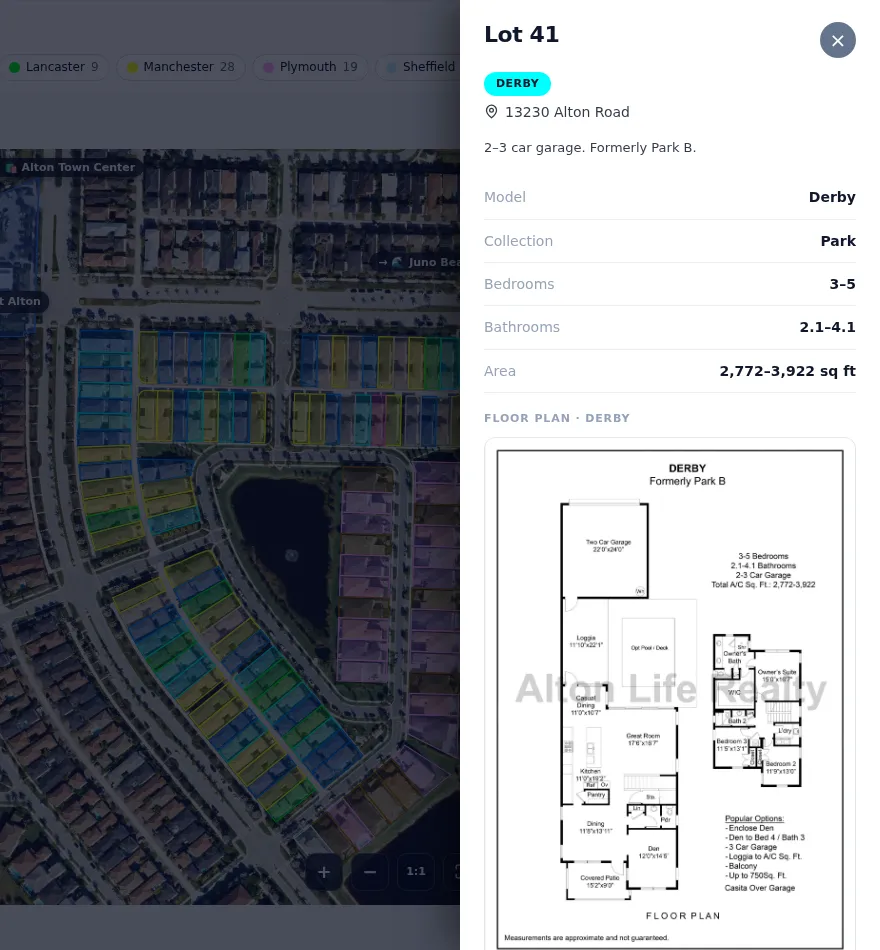 One home on the Alton map we built for Alton Life Realty in Palm Beach Gardens, FL: model, collection, bedrooms, bathrooms, size and floor plan in one panel.
How Do You Farm Without Breaking Fair Housing Rules?
Farming means marketing to everyone in the community the same way, and describing homes, not people.
- The Fair Housing Act bars ads that indicate a preference, limitation or discrimination based on race, color, religion, sex, handicap, familial status or national origin (42 U.S.C. 3604(c)). HUD’s rule applies this to words, photos and the choice of where ads run (24 CFR 100.75).
- HUD’s rule on steering lists discouraging buyers because of the protected characteristics of the people in a community, telling buyers they wouldn’t be “comfortable or compatible” with residents, and assigning buyers to a particular section, when it’s done because of a protected characteristic (24 CFR 100.70).
- If you’re a REALTOR®, Standard of Practice 10-1 of the NAR Code of Ethics says not to volunteer the racial, religious or ethnic composition of any neighborhood, and not to do anything that may result in panic selling or steering.
In practice:
| Describe the property | Don’t describe the people |
|---|---|
| Beds, baths, square feet and the floor plan | Who lives on a street, or who a home “suits” |
| Walking time to the clubhouse or town center | Whether a buyer would feel “comfortable” somewhere |
| Lot features: lake, preserve, corner | The racial, religious or ethnic makeup of a neighborhood |
| HOA fees and rules, with a source and date | Hints that “the neighborhood is changing” |
This isn’t legal advice. Ask your broker about your state’s rules too.
Make the Map the Anchor
Every tactic above works better when it points to one place:
- Your hub sits in your main menu. Alton Life Realty’s map is in the team’s main menu, and a homepage tile links to it.
- Every postcard carries a QR code to the map, and every market update links to the models it mentions.
- Every listing presentation opens it, and every out-of-state buyer gets the link.
The Alton team saw a free demo of one neighborhood the day after their first email, and the full map was ready two days after the deposit. For large communities, see interactive maps for Florida master-planned communities. To put a map on your site, follow how to add an interactive community map to your website.
Pricing (USD): from $2,000 setup plus $600 a year for a small community. Larger communities are quoted after a free demo of one neighborhood. Once we have your site plan or aerial, home list, floor plans and photos, a map can be live in 2 to 3 days; larger communities take longer. For what moves the price, see interactive site plan cost. See the live demo or request a free demo of your community.
Frequently Asked Questions
What turnover rate makes a good farm?
Turnover is closed sales in the last 12 months divided by total homes. RPR’s rule of thumb is at least 5%. Compare candidate communities with the same math, then check who already holds the listings.
How long does farming take to work?
Plan on at least a year. RPR recommends a mix of marketing, including email, social media and direct mail, over at least a one-year period.
Can I describe who lives in the community?
No. Describe homes, amenities and facts. HUD’s rules cover ads that indicate a preference based on a protected characteristic, and steering. REALTORS® must not volunteer a neighborhood’s racial, religious or ethnic composition.
Can I mail every home in the community without a mailing list?
Yes, with USPS Every Door Direct Mail. Choose the carrier routes that cover the community, and every address on them gets your mail, addressed to “Postal Customer”. EDDM Retail takes 200 to 5,000 pieces per day per ZIP Code.
Does a community map connect to the MLS?
No. The map shows every home with its model and floor plan, and any status is set by hand in the dashboard. Nothing syncs with an MLS or CRM, so keep your IDX search beside it.
What does a community map cost?
From US$2,000 setup plus US$600 a year for a small community. Larger communities are quoted after a free demo of one neighborhood. New projects are paid 50% to start, 30% once you’ve tested the working map, and 20% at launch.